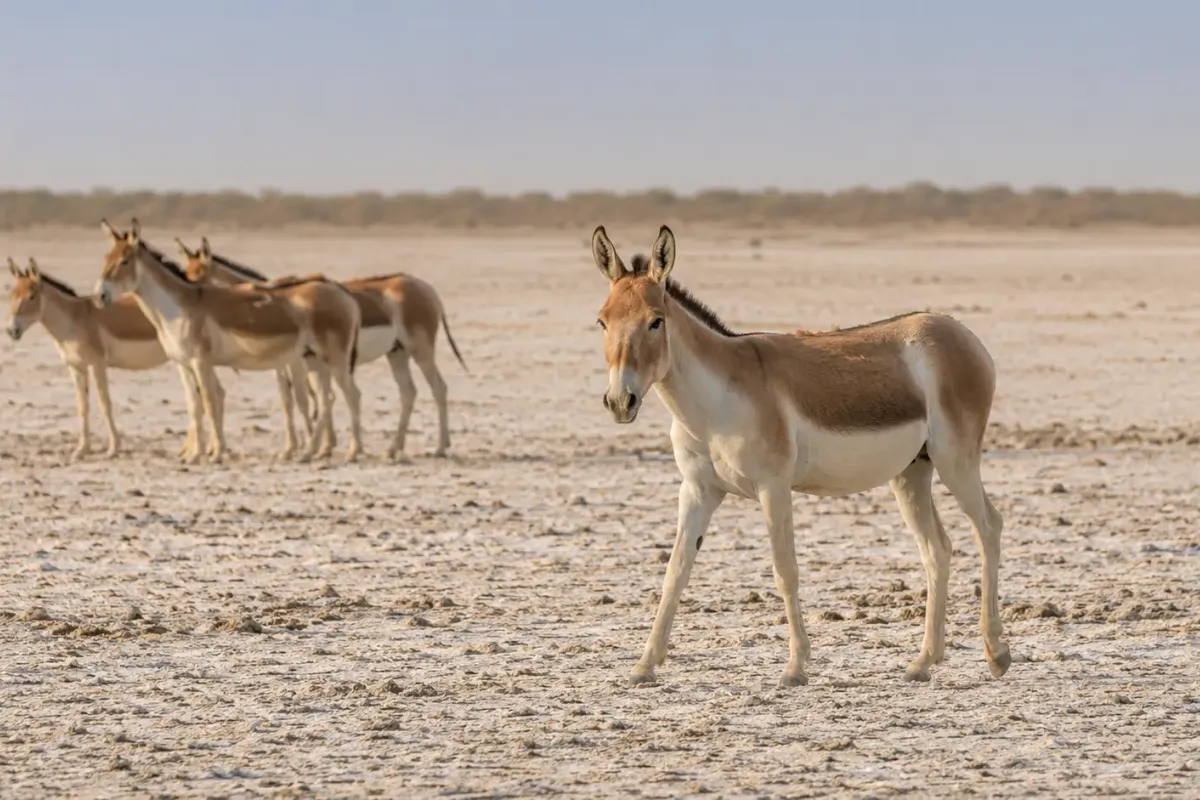
In 1961, the Gujarat Forest Department planted a tree across roughly 315 square kilometres of Banni Grasslands specifically to stop the Rann's salt desert from encroaching further. That tree, Prosopis juliflora, has since spread across more than half the entire grassland. Banni grasslands is genuinely one of India's most ecologically significant landscapes, and this guide covers the real ecosystem, the wildlife, and the honest story behind a well-intentioned fix that became its own crisis.
WHAT IS BANNI GRASSLANDS?
Banni kutch sits on the southern edge of the Great Rann of Kutch, a genuinely vast transition zone between desert and savannah ecosystems, bounded by the Rann to the north and east and the Bhuj uplands to the south and west. Sources disagree meaningfully on its exact size figures range from roughly 2,500 square kilometres up to nearly 3,850 square kilometres for the full Banni Grasslands Reserve, a spread worth knowing about rather than treating any single number as definitive.
The landscape's origin is genuinely ancient: the region emerged from the sea through tectonic activity, with rivers flowing from the Bhuj mainland depositing soil that eventually supported diverse grass species. Pastoral communities have grazed here for at least 500 years, with cultural and trade links extending into Sindh, Balochistan and even Afghanistan. Today, roughly 22 ethnic groups predominantly pastoralist communities including the Maldharis, Rabaris, Jats, Mutwas and Meghwals live across around 48 settlements, with a combined population close to 40,000 people.
THE PROSOPIS PROBLEM: A FIX THAT BECAME A CRISIS
This is the story most kutch ecosystem content leaves out entirely, and it's genuinely important to understanding Banni today. In 1961, Prosopis juliflora a nitrogen-fixing, highly drought- and salt-tolerant tree was deliberately introduced across the grassland to check the encroachment of the Rann's salt pan desert. It worked, in a narrow sense: the tree took hold. But it also out-competed native grasses aggressively, and estimates now suggest it has invaded more than 50% of the entire grassland.
The honest complication is that removing it isn't a simple ecological win. Local Maldhari and pastoralist communities have grown genuinely dependent on Prosopis for firewood, charcoal and fencing material over six decades, meaning large-scale removal while ecologically sound carries real socio-economic costs for the people who now rely on it. Scientists studying the issue describe this as a genuine trade-off rather than an easy fix, and any large-scale removal effort requires both community buy-in and investment most conservation plans haven't fully resourced yet.
"Kutch Nahi Dekha To Kuch Nahi Dekha if you haven't seen Kutch, you haven't seen anything."
— Traditional Gujarati saying
WILDLIFE AND BIODIVERSITY OF BANNI
Banni grassland wildlife is genuinely diverse despite the Prosopis pressure. The grassland hosts 275 recorded bird species, both resident and winter migratory, alongside mammals including Nilgai, Chinkara, Blackbuck, Wild Boar, Golden Jackal, Indian Hare, Indian Wolf, Caracal, Asiatic Wildcat and Desert Fox. Native grass species sources cite anywhere from 37 to over 60 varieties depending on the survey include Cenchrus ciliaris, Dichanthium annulatum, Eleusine compressa and Sehima nervosum, though native tree species like Acacia nilotica and Salvadora persica have declined significantly as Prosopis has spread.
Species Group | Notable Examples | Status Birds | 275 recorded species (resident and migratory) | Consistent across sources Mammals | Indian Wolf, Caracal, Chinkara, Blackbuck, Desert Fox | Genuine biodiversity despite habitat pressure Native grasses | Cenchrus ciliaris, Dichanthium annulatum, Sehima nervosum | 37-60+ species reported, sources vary Native trees | Acacia nilotica, Salvadora persica | Declining due to Prosopis invasion
THE BANNI BUFFALO AND KHARAI CAMEL
Grasslands kutch content rarely goes deep on the livestock breeds that define this landscape, which is a genuine gap given how significant they are. The Banni buffalo, also called "Kutchi" or "Kundi," is a distinct breed bred and preserved by the Maldhari community, officially recognised by ICAR's Breed Registration Committee in 2010 as India's 11th registered buffalo breed. It's genuinely productive yielding roughly 12-18 litres of milk daily and its distinct genetics allow for longer lactation periods and disease resistance compared to more common breeds. These buffaloes travel 8-10 km daily during monsoon and up to 15 km in drier months to reach grazing grounds.
Equally distinctive, though less widely known, is the Kharai camel a genuinely unusual breed capable of swimming into coastal mangroves to forage, alongside the more typical scrub-forest Kachhi camel found elsewhere in Kutch. Together with Kankrej cattle, sheep, goats and horses, these breeds support roughly 80,000 head of livestock across the region, producing over 100,000 litres of milk daily a scale that makes Banni genuinely central to Kutch's dairy economy, not just its tourism appeal.
Ready to Book Your Kutch Trip?
Contact our travel experts for personalized assistance and custom itineraries.
BEST TIME TO VISIT BANNI GRASSLANDS
November through February remains the practical window, consistent with the rest of Kutch's viable tourist season and covered in more depth in our best time to visit kutch guide. Winter brings both comfortable daytime temperatures and peak migratory bird activity, making it the strongest combination for wildlife viewing specifically.
If your visit overlaps with Rann Utsav's full-moon dates, covered in our rann utsav dates guide, you can combine a Banni visit naturally with your Tent City stay, since the grassland sits directly between Bhuj and the White Rann.
HOW TO REACH AND WHAT TO SEE
Banni Grasslands is easily combined with a White Rann trip, since it sits directly along the route between Bhuj and Dhordo. Hodka village, a well-known Banni community settlement known for mirror-work embroidery and traditional round mud-and-thatch bhunga homes, is the most commonly visited entry point for travellers wanting to experience the grassland's pastoral culture directly rather than just driving through.
Most visitors see Banni as part of a broader Rann Utsav circuit rather than a dedicated standalone trip, and that's genuinely the sensible approach given how naturally it sits along the existing Bhuj-to-Dhordo corridor.
COST OF VISITING BANNI GRASSLANDS
Here's a realistic cost breakdown for incorporating a Banni Grasslands stop into your Kutch trip, per person.
Category | Budget | Mid-Range | Luxury Entry/access | Free (public grassland route) | Free | Free Hodka village homestay experience (if overnight) | ₹1,500-2,500 | ₹3,000-5,000 | ₹6,000-9,000 Local guide/naturalist (optional) | ₹500-800 | ₹1,000-1,500 | ₹2,000-3,000 (specialist wildlife guide) Transport (bundled into Bhuj-Dhordo route, no separate cost) | Included in existing transfer | Included in existing transfer | Included in existing transfer
Prices as of Month 5 (December 2026), built from typical Hodka homestay rates and local guide fees verify current rates before booking, since homestay pricing and availability can shift seasonally.
12 PRACTICAL TIPS FOR VISITING BANNI GRASSLANDS
1. Combine your visit with the Bhuj-to-Dhordo drive rather than planning a separate trip, since Banni sits directly along that existing route.
2. Visit Hodka village specifically if you want genuine cultural context alongside the landscape itself, not just a drive-through view.
3. Bring binoculars if birdwatching interests you at all, given the 275 recorded species here.
4. Visit during winter months for the best combination of comfortable weather and peak migratory bird activity.
5. Ask a local guide about the Prosopis situation if you're genuinely curious it's a real, ongoing conservation debate, and locals often have direct, personal perspectives worth hearing.
6. Look out for Banni buffalo herds specifically, since spotting this ICAR-recognised breed up close is a genuinely distinctive experience most Kutch itineraries skip.
7. Respect grazing land and livestock, since this remains an actively used pastoral landscape, not an empty scenic backdrop.
8. Carry water and snacks if you're spending extended time exploring beyond the main road, since facilities are sparse across the grassland itself.
9. Mobile network coverage is inconsistent across much of Banni download offline maps if you're driving through independently.
10. Photograph early morning or late afternoon for the best light across the flat grassland terrain.
11. If staying overnight at a Hodka homestay, confirm exactly what's included, since experiences vary meaningfully between operators.
12. Treat this as a landscape to understand, not just photograph the pastoral communities and their livestock are as much a part of Banni's story as the grasses and wildlife.
FREQUENTLY ASKED QUESTIONS
What is Banni Grasslands known for? It's one of India's largest arid grassland ecosystems, home to 275 bird species, distinctive wildlife like the Indian Wolf and Caracal, and the ICAR-recognised Banni buffalo breed, alongside a genuine ongoing conservation debate over the invasive Prosopis juliflora tree.
How big is Banni Grasslands? Sources genuinely disagree, ranging from roughly 2,500 square kilometres to nearly 3,850 square kilometres depending on which official source or study you check.
What is the Prosopis problem in Banni Grasslands? A tree introduced in 1961 to stop desert encroachment has since spread across more than 50% of the grassland, out-competing native species. Removing it is ecologically sound but carries real economic costs for communities now dependent on it for firewood and fencing.
What is the Banni buffalo? A distinct buffalo breed bred by the Maldhari pastoralist community, officially recognised by ICAR in 2010 as India's 11th registered buffalo breed, known for high milk yield, disease resistance and longer lactation periods than common breeds.
When is the best time to visit Banni Grasslands? November through February, matching the rest of Kutch's viable tourist season, with winter offering both comfortable weather and peak migratory bird activity.
Can I combine Banni Grasslands with a Rann Utsav trip? Yes, easily. The grassland sits directly along the route between Bhuj and Dhordo, making it a natural stop rather than a separate excursion, especially via Hodka village.
Is Banni Grasslands a protected area? Parts of it, yes. The Kutch Desert Wildlife Sanctuary and Chhari Dhand Conservation Reserve both sit within the broader Banni Grasslands landscape, though the grassland as a whole includes actively grazed pastoral land beyond these specific protected zones.
FINAL VERDICT: IS BANNI GRASSLANDS WORTH THE VISIT?
Yes, genuinely, especially if you want a fuller understanding of Kutch beyond the White Rann's salt flats. The scale of the pastoral economy here 80,000 livestock, over 100,000 litres of milk daily, an officially recognised buffalo breed reveals a working landscape most Rann Utsav visitors drive straight through without realising what they're seeing.
It doesn't need a dedicated separate trip, and that's genuinely the point: Banni sits naturally along your existing Bhuj-to-Dhordo route, so build in time to actually notice it a Hodka village stop, a slower drive, a conversation with a local guide about the Prosopis debate rather than treating it as empty landscape between two more famous destinations.
About the author: This guide was compiled by the IVARA Journeys travel team, who curate premium and pilgrimage travel packages across Gujarat, including Banni Grasslands and Hodka village cultural excursions. Last visited Kutch: December 2026.
Ready to build Banni into your Kutch itinerary properly? Talk to our Kutch travel expert (/contact) or explore our Rann Utsav packages (/packages/rann-utsav-kutch) and for the complete season calendar and best months to visit, our best time to visit kutch and rann utsav dates guides help you plan the timing.
Ready to Experience This?