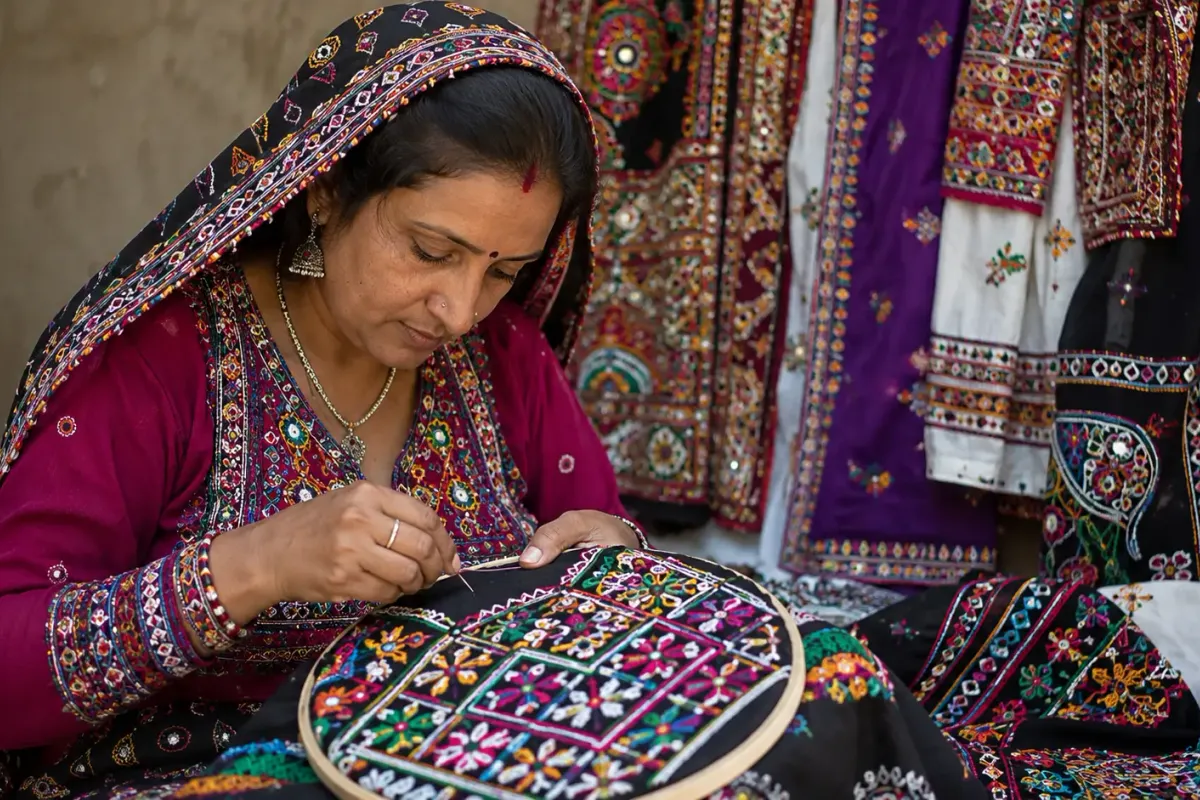
Bhujodi village's signature motifs aren't embroidered onto fabric after weaving, and they're not printed on either they're woven directly into the cloth itself, thread by thread, using a technique that takes years to master. Bhujodi is believed to be Kutch's first weaver settlement, roughly 500 years old, and the "Kutch Shawl" it produces carries an official Geographical Indication tag protecting it from imitation. This guide covers the real weaving technique, the artisans keeping it alive, and exactly what to buy.
THE HISTORY OF BHUJODI: KUTCH'S FIRST WEAVER SETTLEMENT
Bhujodi village is genuinely old by any measure approximately 500 years, with roughly 4,000 residents today, and widely believed to be Kutch's very first weaver settlement, established even before Bhuj itself. The Vankar weaving community here traces its roots to the Meghwal community, who migrated from Rajasthan around five centuries ago. Local folklore adds a mythical layer to this history too: some accounts describe the Vankars as originally sent by Lord Shiva to tend camels belonging to Parvati, a story still told alongside the more documented migration history.
What genuinely shaped Bhujodi's craft, though, was its centuries-long economic relationship with the Rabari pastoralist community. Rabari herders supplied raw sheep and camel wool to the Vankar weavers, who spun, dyed and wove it into blankets, shawls and garments often commissioned specifically for Rabari weddings and ceremonies. That symbiotic exchange, herder and weaver depending on each other for generations, shaped the textures and forms Bhujodi remains known for today.
WHAT MAKES BHUJODI WEAVING UNIQUE: THE EXTRA-WEFT TECHNIQUE
Bhujodi weaving's defining feature is its extra-weft technique, and it's worth understanding properly since most visitors assume the motifs are embroidered afterward. They're not. Between regular weft insertions on the loom, weavers use a small shuttle carrying a different-coloured yarn, manually counting threads to build up small geometric motifs as the fabric itself takes shape a technique that genuinely resembles embroidery in appearance but is structurally woven, not stitched on. A single error in counting means restarting the section from scratch, which gives some sense of the concentration this demands.
The traditional motifs have names of their own patterns like dholki, vakhiyo and chaumukh small repeated geometric designs that artisans describe as inspired by architectural elements, including the carved stonework of forts and stepwells like Rani ki Vav in Patan. In recent decades, master weaver Shamji Vankar has also incorporated Kala Cotton into Bhujodi's output a short-staple, rain-fed cotton variety genuinely indigenous to Kutch, offering a rustic, matte texture distinct from the glossier commercial cotton used elsewhere. Raw materials otherwise come from across India: wool from Ludhiana, silk from Bengaluru, cotton from West Bengal, alongside local goat, camel and sheep wool still used for specific traditional pieces.
Technique Element | What It Actually Is Extra-weft motifs | Woven directly into the fabric structure, not embroidered or printed afterward Named traditional patterns | Dholki, vakhiyo, chaumukh geometric designs inspired by architectural carving Kala Cotton | Indigenous, short-staple, rain-fed Kutch cotton, incorporated by master weaver Shamji Vankar Raw material sourcing | Wool from Ludhiana, silk from Bengaluru, cotton from West Bengal, plus local wool
"Kutch Nahi Dekha To Kuch Nahi Dekha if you haven't seen Kutch, you haven't seen anything."
— Traditional Gujarati saying
MEET THE MASTER WEAVERS
Bhujodi weaving content rarely names actual artisans, which undersells how much of this tradition is tied to specific, recognisable individuals. Shamji Vankar, full name Shamji Vishram Valji, is among the most internationally recognised his father, Vankar Vishram Valji, received India's National Master Craftsman's Award in 1974 for Dhabla weaving, a traditional blanket-and-shawl style. Shamji has since built on that legacy, working with roughly 90 weaving and dyeing families and collaborating with designers including Anita Dongre, whose "Earth Song" collection drew on Bhujodi techniques, and home decor designer Chinar Farooqi.
Chaman Siju is another widely respected Kutchi vankar, known for weaving demonstrations at events including the Kala Ghoda Arts Festival, where he's spoken publicly about the tension between preserving traditional materials and adapting to modern market demands. The "Kutch Shawl" itself received formal Geographical Indication recognition on 17 October 2011, granted to the Kutch Weavers' Association in Bhuj official protection benefiting roughly 1,200 Vankar and Meghwal samaj weavers across the wider region, not just Bhujodi itself.
Planning Your Kutch Trip?
Contact our travel experts for personalized assistance and custom itineraries.
SHOPPING IN BHUJODI: WHAT TO BUY AND WHERE
Bhujodi kutch shopping genuinely rewards visiting individual workshops rather than relying solely on a single outlet nearly 200 expert craftspeople work in the village, many happy to demonstrate their loom technique before you buy. The Hiralaxmi Memorial Craft Park, located close to the village, brings multiple Kutch artisan traditions together under one roof, genuinely useful if you're short on time or want a curated overview before deciding which individual workshops to visit.
Product range extends well beyond the classic shawl: sarees, dupattas, stoles, pillow covers, bedsheets and curtains are all commonly available, alongside the traditional Dhabla blanket style Shamji Vankar's family is particularly known for. If sustainability and indigenous materials matter to your purchase, specifically ask about Kala Cotton pieces, since not every workshop uses it by default.
HOW TO REACH BHUJODI
Bhujodi sits roughly 8 km from Bhuj, genuinely the most accessible of Kutch's major craft villages and an easy add-on to a Bhuj city day rather than a dedicated separate trip. Most visitors combine it with Ajrakhpur, about 15 km from Bhuj, as part of a broader craft-village circuit our kutch handicrafts guide covers the full circuit including Nirona if you want to build a complete craft day.
COST OF BHUJODI TEXTILES
Here's a realistic price range for Bhujodi purchases, based on current retail listings from established Kutch craft sellers.
Item | Budget | Mid-Range | Luxury Handwoven cotton dupatta | ₹1,900-2,650 | ₹3,000-3,500 | ₹4,500-7,000 (silk-blend) Kala Cotton stole | ₹2,000-2,750 | ₹2,750-3,500 | ₹4,000-6,000 (fine weave, natural dye) Wool shawl | ₹3,200-5,000 | ₹5,000-8,500 | ₹8,500-10,500 (pure wool, silk-embellished edges) Dhabla blanket/shawl | ₹4,000-6,000 | ₹6,000-10,000 | ₹10,000-20,000+ (master weaver pieces, extra-weft silk work)
Prices as of Month 3 (October 2026), built from current listings on established Kutch craft retail platforms verify current pricing directly with individual weavers, since master-weaver and extra-weft silk pieces specifically vary widely by complexity.
11 PRACTICAL TIPS FOR VISITING BHUJODI
1. Visit individual workshops rather than relying solely on the Hiralaxmi Craft Park if you want to see the extra-weft technique demonstrated firsthand.
2. Ask specifically about Kala Cotton if indigenous, sustainable materials matter to your purchase not every piece uses it.
3. Look for the GI-tagged "Kutch Shawl" designation if authenticity documentation matters to you specifically.
4. Combine your visit with Ajrakhpur, roughly 15 km away, for a fuller craft-village day rather than visiting Bhujodi alone.
5. Ask weavers to explain the difference between extra-weft motifs and embroidery it's a genuinely interesting distinction most visitors don't know to ask about.
6. Carry cash for smaller individual workshops, where card payment isn't always available.
7. Bargain respectfully, but recognise that master-weaver pieces with complex extra-weft silk work carry genuine skill and time costs.
8. Visit in the morning if you want to see weavers actively working at their looms rather than just browsing finished pieces.
9. If buying a Dhabla specifically, ask about the weaving family's lineage several Bhujodi families carry award-winning craft histories worth knowing about.
10. Photograph the loom process with permission most weavers are genuinely happy to explain their technique to interested visitors.
11. Check care instructions for natural-dye and Kala Cotton pieces specifically, since they often need gentler washing than synthetic-dye equivalents.
FREQUENTLY ASKED QUESTIONS
What is Bhujodi village famous for? Bhujodi is Kutch's oldest known weaver settlement, roughly 500 years old, home to the Vankar community and famous for its extra-weft handloom weaving technique, which produces the GI-tagged "Kutch Shawl."
What is the extra-weft technique in Bhujodi weaving? A technique where a small shuttle carrying differently-coloured yarn is manually worked between weft insertions to build geometric motifs directly into the fabric as it's woven, rather than embroidering or printing patterns on afterward.
Does the Kutch Shawl have a GI tag? Yes. It received official Geographical Indication recognition on 17 October 2011, granted to the Kutch Weavers' Association in Bhuj, benefiting roughly 1,200 Vankar and Meghwal weavers across the region.
What is Kala Cotton? A short-staple, rain-fed cotton variety indigenous to Kutch, incorporated into Bhujodi weaving by master weaver Shamji Vankar, offering a rustic, matte texture distinct from glossier commercial cotton.
How far is Bhujodi from Bhuj? Roughly 8 km, making it the most accessible of Kutch's major craft villages and an easy half-day add-on to a Bhuj city visit.
Who are Bhujodi's notable master weavers? Shamji Vankar (Shamji Vishram Valji), whose father won India's National Master Craftsman's Award in 1974, and Chaman Siju, both widely recognised for their weaving demonstrations and craft advocacy.
What should I buy in Bhujodi? Shawls, dupattas, stoles and the traditional Dhabla blanket style are all commonly available, with Kala Cotton pieces worth specifically asking for if sustainable, indigenous materials matter to your purchase.
FINAL VERDICT: IS BHUJODI VILLAGE WORTH VISITING?
Yes, genuinely, and it's one of the easiest craft villages to add to a Kutch trip given its short distance from Bhuj. Watching the extra-weft technique in person motifs building up thread by thread rather than stitched or printed on changes how you understand what you're buying, and meeting weavers whose families carry generations of award-winning craft history adds real depth beyond a standard souvenir stop.
Combine it with Ajrakhpur for a fuller craft-village half-day, and don't rush the workshop visits the weavers here are generally glad to explain their technique, and that context is worth more than a quick browse-and-buy.
About the author: This guide was compiled by the IVARA Journeys travel team, who curate premium and pilgrimage travel packages across Gujarat, including Kutch craft-village circuits. Last visited Kutch: October 2026.
Ready to add Bhujodi to your Kutch itinerary? Talk to our Kutch travel expert (/contact) or explore our Rann Utsav packages (/packages/rann-utsav-kutch) and for the complete craft-village circuit including Ajrakhpur and Nirona, our kutch handicrafts guide and bhuj tourist places guide round out your Bhuj-area planning.
Ready to Experience This?