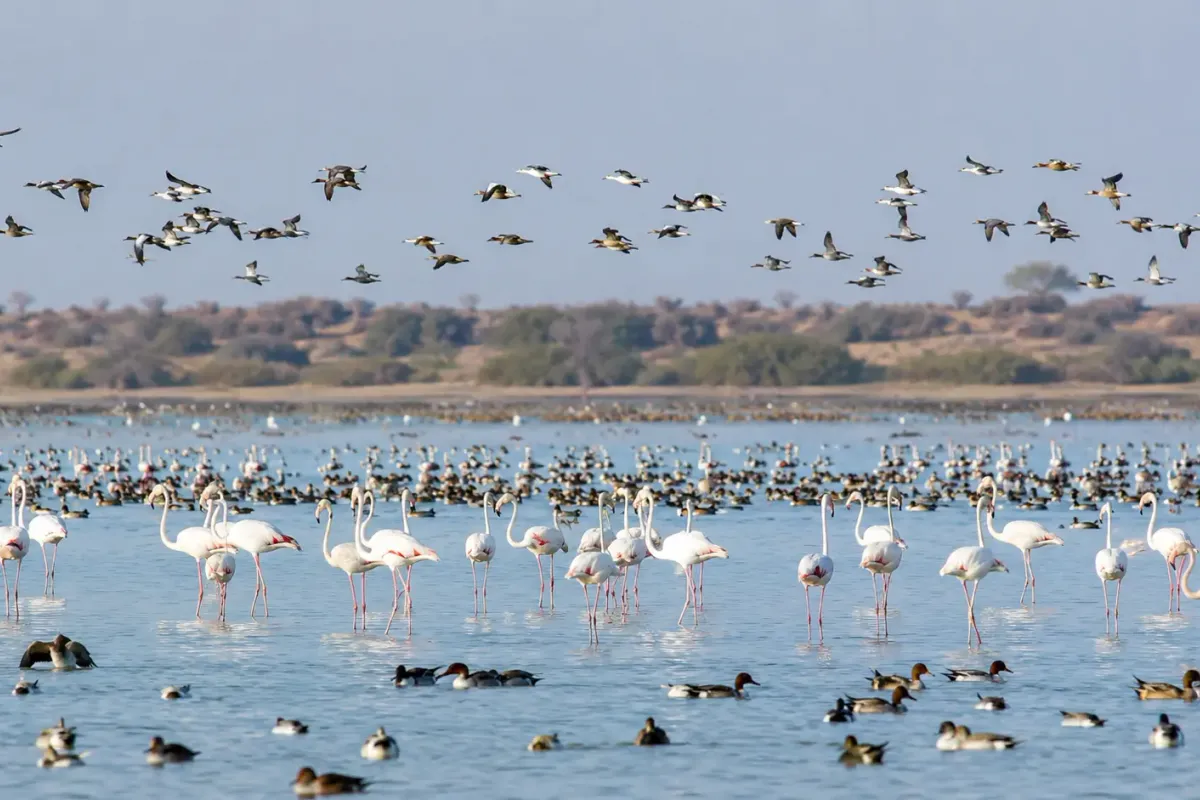
Local Kutchi communities call the ghost lights that appear over Chhari Dhand's marshy flats after dark "Chir Batti" unexplained luminous phenomena that folklore attributes to spirits, and science attributes to marsh gases. Chhari dhand is genuinely one of Kutch's richest wildlife spots, home to nearly two lakh birds during peak migration, and this guide covers the real species you'll see, the permit process, and the honest logistics of getting there.
WHAT IS CHHARI DHAND?
Chhari dhand wetland takes its name from Kutchi language roots "chhari" means salty, "dhand" means shallow wetlands an accurate description of a seasonal desert wetland that floods during monsoon and gradually recedes through winter. It sits on the edge of the arid Banni grasslands, bordering the marshy salt flats of the Great Rann of Kutch, within Nakhatrana Taluka.
The Gujarat government formally notified the site as a Conservation Reserve under Section 36A of the Wildlife (Protection) Act, 1972, on 16 July 2008. This is a genuinely important distinction worth understanding: Conservation Reserve status offers moderate protection prohibiting hunting and habitat destruction while still permitting regulated traditional activities like grazing by local pastoralist communities rather than the stricter designation of a full wildlife sanctuary. Reports suggest the higher sanctuary status wasn't pursued specifically due to administrative complications around overlapping land use in the area. On size, sources genuinely disagree by a significant margin: some describe the wetland as "over 80 square kilometres," while the official 2008 government notification reportedly covers 227 square kilometres treat the smaller figure as describing the core wetland area itself, and the larger figure as the full conservation reserve boundary, though neither source fully clarifies the distinction.
BIRDS YOU CAN SEE AT CHHARI DHAND
Bird watching kutch has few better spots than this reserve. Chhari Dhand hosts endangered species including the Dalmatian Pelican, Oriental Darter, Black-necked Stork and Indian Skimmer, alongside thousands of flamingos, Painted Storks, Spoonbills and various raptors that pass through during the migratory season.
The reserve's scientific credibility runs deep the Bombay Natural History Society (BNHS) began bird migration studies here in the 1980s using banding techniques, work that continued through the 1990s and beyond. Their research documented roughly 40,000 Common Cranes wintering across Banni grasslands and Chhari Dhand during good rainfall years, part of an estimated 70,000 cranes across the wider Kutch district a meaningful share of the entire Central Asian Flyway's crane population. BNHS banding data has also tracked cross-border bird movements, helping establish the reserve's importance well beyond Gujarat's own conservation interests.
Species | Status | Season Typically Seen Dalmatian Pelican | Endangered | Winter Oriental Darter | Endangered | Winter Black-necked Stork | Endangered | Winter Indian Skimmer | Endangered | Winter Common Crane | Migratory (up to ~40,000 in good years) | Winter Flamingo | Migratory, thousands | Monsoon-winter
"Kutch Nahi Dekha To Kuch Nahi Dekha if you haven't seen Kutch, you haven't seen anything."
— Traditional Gujarati saying
THE CHIR BATTI LEGEND: GHOST LIGHTS OF CHHARI DHAND
This is the detail most competing chhari dhand bird sanctuary guides leave out entirely, and it's genuinely one of the more interesting pieces of local folklore in Kutch. Kutchi communities describe unexplained luminous phenomena, known as Chir Batti, appearing over the marshy flats after dark floating, flickering lights with no obvious source. Local tradition attributes them to spirits; the more grounded explanation points to marsh gases igniting or reflecting light under specific conditions.
Whatever the true cause, the legend functions as a genuine cautionary tale for travellers navigating this isolated terrain after nightfall a practical reminder, wrapped in folklore, that this is remote wetland territory best explored in daylight rather than after dark.
CHHARI DHAND TIMINGS, PERMITS AND ENTRY
The reserve is open sunrise to sunset, with no formal entry fee charged at the site itself. That said, visitors need a permit from the Forest Department office in either Bhuj or Nakhatrana, typically costing roughly ₹100-200 per vehicle. Arrange this before heading out rather than assuming you can obtain it on arrival at the reserve boundary itself.
A Gujarat Forest Department watchtower, roughly 30 feet high, gives visitors a genuinely panoramic view over the wetland the single best vantage point for birdwatching without disturbing the birds themselves. A small, basic forest guest house sits nearby, built in an eco-friendly style using local stone and thatch, though don't expect resort-level amenities this far into the reserve.
Planning Your Kutch Trip?
Contact our travel experts for personalized assistance and custom itineraries.
HOW TO REACH CHHARI DHAND
This is genuinely one of the wider distance disagreements in Kutch tourism content sources put Chhari Dhand anywhere from 50 km to 80 km from Bhuj, with figures of 54 km, 79.1 km and 80 km all appearing across different sources. Distance from Nakhatrana town is more consistent, cited at roughly 25-40 km depending on the exact route taken.
Given this spread, budget genuinely flexible time rather than planning tightly around any single distance figure. The reserve connects reasonably well by road from Bhuj, Mandvi and Bhachau, and Bhuj remains your best base for arranging both transport and your Forest Department permit in the same trip.
Reference Point | Distance Bhuj (lowest reported) | ~50-54 km Bhuj (highest reported) | ~79-80 km Nakhatrana town | ~25-40 km White Rann/Rann of Kutch | ~60 km
BEST TIME TO VISIT CHHARI DHAND
Monsoon and winter are both genuinely productive seasons here, though for different reasons. Monsoon rains flood the wetland and draw the first migratory arrivals; winter, roughly November through February, is when bird numbers peak and viewing conditions are most comfortable for visitors, aligning conveniently with the same season that makes the rest of Kutch including Rann Utsav itself worth visiting.
Early morning is genuinely the best time of day regardless of season, both for bird activity and for beating the heat if you're visiting toward the warmer edges of the viable window.
COST OF VISITING CHHARI DHAND
Here's a realistic cost breakdown for a Chhari Dhand visit, per person.
Category | Budget | Mid-Range | Luxury Forest Department permit (per vehicle) | ₹100-200 | ₹100-200 | ₹100-200 Transport from Bhuj (round trip, shared) | ₹1,500-2,500 | N/A | N/A Private cab from Bhuj (round trip) | N/A | ₹4,500-6,500 | ₹7,500-10,000 (SUV) Local guide/naturalist (optional) | ₹500-800 | ₹1,000-1,500 | ₹2,000-3,000 (specialist birding guide)
Prices as of Month 4 (November 2026), built from current Forest Department permit fee ranges and typical Kutch local cab rates verify current permit costs and transport pricing before travelling, since this route has genuinely fewer operators than the main Bhuj-Dhordo corridor.
11 PRACTICAL TIPS FOR VISITING CHHARI DHAND
1. Arrange your Forest Department permit in Bhuj or Nakhatrana before heading to the reserve, rather than assuming it's available on arrival.
2. Visit early morning for the best bird activity and most comfortable conditions.
3. Use the Forest Department watchtower for the best panoramic viewing without disturbing wildlife directly.
4. Bring binoculars and a proper zoom lens if photography matters to you; birds here keep a respectful distance from visitors.
5. Budget flexible travel time given how widely sources disagree on the exact distance from Bhuj.
6. Carry your own water and snacks; there are no shops near the reserve itself.
7. Avoid the site after dark, both for practical safety in remote terrain and out of respect for the local Chir Batti folklore.
8. Combine your visit with nearby Dhinodhar Hill or Than Monastery if you have extra time in the same direction from Bhuj.
9. Hire a local naturalist guide if you're serious about identifying specific species, since the sheer diversity here can overwhelm an unguided visit.
10. Dress in neutral, muted colours rather than bright clothing, which can disturb birds at closer viewing distances.
11. Check current road conditions before setting out, particularly during or just after monsoon season when the access route can be affected by standing water.
FREQUENTLY ASKED QUESTIONS
What is Chhari Dhand famous for? It's one of Kutch's richest birdwatching sites, home to nearly 2 lakh birds during migration season, including endangered species like the Dalmatian Pelican and Black-necked Stork, alongside thousands of Common Cranes and flamingos.
What is the entry fee for Chhari Dhand? There's no formal entry fee at the site itself, but visitors need a Forest Department permit costing roughly ₹100-200 per vehicle, obtained from the office in Bhuj or Nakhatrana.
How far is Chhari Dhand from Bhuj? Sources disagree significantly, ranging from roughly 50 km to 80 km. Budget flexible travel time rather than planning tightly around a single figure.
What is the best time to visit Chhari Dhand for birdwatching? Winter, roughly November through February, offers peak bird numbers and the most comfortable viewing conditions, though the wetland also draws early migratory arrivals during monsoon.
Is Chhari Dhand a wildlife sanctuary? Not officially. It holds Conservation Reserve status under the Wildlife Protection Act, notified in 2008 a moderate protection level that permits regulated traditional activities like grazing, distinct from the stricter designation of a full wildlife sanctuary.
What is the Chir Batti phenomenon at Chhari Dhand? Unexplained luminous lights reported over the wetland's marshy flats after dark, attributed by local folklore to spirits and by more grounded explanations to marsh gases. It also serves as a practical caution against navigating the isolated terrain at night.
How big is the Chhari Dhand wetland? Sources genuinely disagree some cite roughly 80 square kilometres for the core wetland, while the official 2008 government notification reportedly covers 227 square kilometres for the full conservation reserve boundary.
FINAL VERDICT: IS CHHARI DHAND WORTH THE VISIT?
Yes, particularly for serious birdwatchers and photographers, or anyone wanting a genuinely different Kutch experience beyond the White Rann and Bhuj's heritage circuit. Nearly two lakh birds, BNHS-documented crane populations in the tens of thousands, and endangered species you won't easily see elsewhere in India make this a legitimate wildlife destination rather than a minor add-on.
It's less essential if wildlife specifically isn't a priority for your trip the permit process and distance uncertainty demand real planning effort for a reward that's specifically about birds, not broader Kutch sightseeing. For anyone with even a passing interest in birdwatching, though, this is worth building real time around rather than skipping in favour of a rushed Rann Utsav-only itinerary.
About the author: This guide was compiled by the IVARA Journeys travel team, who curate premium and pilgrimage travel packages across Gujarat, including Kutch wildlife and birdwatching excursions. Last visited Kutch: November 2026.
Ready to add Chhari Dhand to your Kutch itinerary? Talk to our Kutch travel expert (/contact) or explore our Rann Utsav packages (/packages/rann-utsav-kutch) and for the complete list of Kutch's best destinations, our kutch tourism guide and how to reach kutch guide help you plan the full trip.
Ready to Experience This?