Ten symbols, each roughly 37 centimetres tall, sit carved into a signboard near Dholavira's north gate one of the longest inscriptions the Indus Valley civilisation ever left behind, and nobody has ever deciphered it. Dholavira is genuinely unlike anywhere else in Kutch, a 5,000-year-old planned city that most Rann Utsav itineraries skip entirely because it demands real commitment to reach. This guide covers what you'll actually see, what it costs, and whether the detour is worth your time.
WHAT IS DHOLAVIRA? A 5,000-YEAR-OLD HARAPPAN CITY
Dholavira kutch refers to one of the most significant Indus Valley Civilisation sites in India, located near Khadir Bet island in Bhachau Taluka, on the Tropic of Cancer. Locally known as Kotada, meaning "large fort," the site was inhabited for at least 1,500 years, passing through nearly every stage of Harappan culture from roughly 2900 BCE to 1500 BCE a continuity most other Harappan sites don't show, since many reveal only their early or late phases rather than the full arc.
The site was officially identified by archaeologist Jagatpati Joshi in 1967-68, with excavations continuing under Ravindra Singh Bisht of the Archaeological Survey of India until 2005. UNESCO inscribed it as a World Heritage Site on 27 July 2021, under the official name "Dholavira: a Harappan City" Gujarat's fourth UNESCO listing and one of India's most important archaeological credentials. Sources differ on exactly how it ranks nationally: one places it as the second-largest Indus Valley site in India after Rakhigarhi and sixth-largest on the subcontinent; another describes it simply as one of the two largest Harappan sites in India. Either way, its scale and significance are not in dispute, even if the precise ranking varies by source.
DHOLAVIRA ARCHAEOLOGICAL SITE: WHAT YOU'LL ACTUALLY SEE
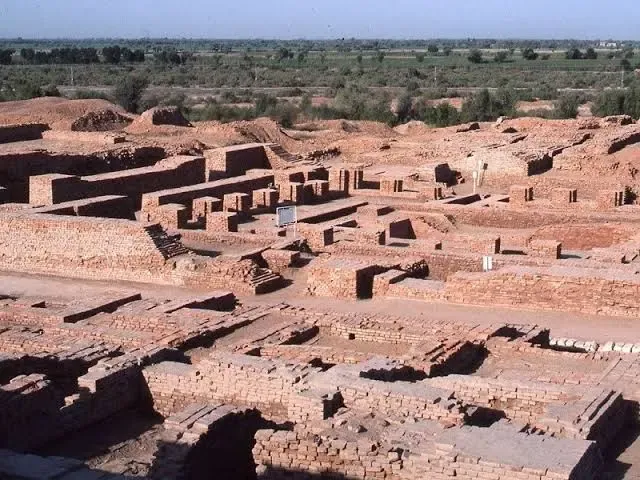
The dholavira archaeological site spans roughly 100 hectares of semi-arid land, with the core fortified city covering about 54 acres, laid out as a rough parallelogram running east to west. What makes Dholavira genuinely unique among Harappan sites is its three-part division Citadel, Middle Town and Lower Town, each separately fortified a configuration found nowhere else in the Indus Valley civilisation's known sites.
The Citadel, comprising the Castle and Bailey sections, is where most walking tours concentrate, taking in the water channels, reservoirs and the fortified North Gate. This is also where you'll find Dholavira's most famous discovery: a signboard bearing ten large Indus script symbols, each about 37 centimetres tall, arranged across a board nearly 3 metres long. The letters were originally crafted from white gypsum and mounted on a wooden frame that has since rotted away, leaving only the symbols in place on the ground. Archaeologist R.S. Bisht dates it to Stage IV of classical Harappan culture, and like the rest of the Indus script, it remains undeciphered to this day.
Beyond the Citadel, the Middle Town holds a large stadium-like ground with a partially excavated seating arrangement, believed to have served festivities, ceremonies or as a marketplace much of it remains unexcavated. The Lower Town contains residential blocks and systematic lanes, while a separate cemetery complex reveals something distinctive about Dholavira's burial customs: most graves are memorial in nature, containing precious stones and grave goods rather than actual human remains, unlike the skeletal burials found at most other Harappan sites.
Site Section | What's There | Notable Feature Citadel (Castle and Bailey) | Fortified core, water channels, North Gate | The undeciphered 10-symbol signboard inscription Middle Town | Large stadium ground, partially excavated | Seating arrangement, likely a market or ceremonial space Lower Town | Residential blocks, systematic lanes | Evidence of organised urban planning Cemetery | Memorial burials | Mostly grave goods rather than skeletal remains, unusual for Harappan sites
Dholavira's water management system is arguably its single most remarkable feature. Archaeologists have identified at least 16 reservoirs forming a cascading system, engineered specifically for rainwater harvesting in a landscape with genuinely scarce freshwater reputed to be among the earliest water conservation systems ever excavated anywhere in the world. An underground drainage system for sanitation runs alongside it, evidence of urban planning sophistication that predates most comparable ancient cities by centuries.
"Kutch Nahi Dekha To Kuch Nahi Dekha if you haven't seen Kutch, you haven't seen anything."
— Traditional Gujarati saying
DHOLAVIRA MUSEUM
The on-site Dholavira Archaeological Museum houses artefacts recovered during decades of excavation ceramics, beads, shell objects, semi-precious stones, copper items including ingots and fishhooks, seals, terracotta unicorn figurines, stone bangles, gold pieces, and pottery. Several items point to established trade links with West Asia, reinforcing Dholavira's role as a genuinely connected trading centre rather than an isolated settlement.
Planning Your Kutch Trip?
Contact our travel experts for personalized assistance and custom itineraries.
DHOLAVIRA TIMINGS AND ENTRY FEE
This is genuinely one area where sources disagree meaningfully, and it's worth knowing before you plan your visit rather than discovering the discrepancy at the gate. One detailed visitor account reports free entry with the site open sunrise to sunset; another cites a ticket price of ₹5 for the excavation site and museum combined, with fixed hours of 10:00 AM to 5:00 PM. Both sources agree on one point: the museum is closed on Fridays, so avoid planning your visit around that specific day.
Given this disagreement, confirm current timings and any entry fee directly with the ASI or your tour operator before travelling, rather than assuming either figure with certainty. Budget 2-3 hours to properly explore both the excavation site and museum this isn't a quick 30-minute stop, and rushing it misses most of what makes the site worth the drive in the first place.
HOW TO REACH DHOLAVIRA
Distance figures from Bhuj vary by source, ranging from roughly 210 km up to 250 km, translating to a 4 to 6-hour drive via Bhachau and Rapar. Given this range and the genuine remoteness of the location, treat Dholavira as a full-day excursion at minimum, or better, an overnight trip attempting it as a rushed day-trip bolted onto an already-packed Rann Utsav itinerary is the most common way visitors end up disappointed.
Road conditions are generally reasonable along the main route, but this is genuinely remote territory fuel stations and food stops thin out considerably compared to the Bhuj-Dhordo corridor, so plan accordingly and fill your tank before setting out.
BEST TIME TO VISIT DHOLAVIRA
October through February is the practical window, aligning with the same season that makes the rest of Kutch viable outside this period, daytime heat in this genuinely exposed, shade-limited site becomes a serious concern. Early morning visits specifically offer the best light for photography and noticeably more comfortable walking conditions, since much of the site involves exposed stone and sand with minimal shade cover.
COST OF VISITING DHOLAVIRA
Here's a realistic cost breakdown for a Dholavira excursion from Bhuj, per person.
Category | Budget | Mid-Range | Luxury Entry fee (site + museum) | ₹5-free (sources vary) | ₹5-free (sources vary) | ₹5-free (sources vary), often bundled into guided tours Local guide (optional, recommended) | ₹500-800 | ₹800-1,200 | ₹1,500-2,000 (private guide) Transport, round trip from Bhuj (shared) | ₹1,500-2,500 | N/A | N/A Private cab, round trip from Bhuj | N/A | ₹5,500-7,500 | ₹9,000-12,000 (SUV) Overnight stay near Dholavira (if not day-tripping) | ₹1,500-2,500 | ₹3,500-6,000 | ₹8,000-12,000
Prices as of Month 3 (October 2026), built from current visitor reports and typical Gujarat highway cab rates for this distance verify current entry fees and transport costs before travelling, given the genuine disagreement in available sources on the entry fee specifically.
13 PRACTICAL TIPS FOR VISITING DHOLAVIRA
1. Confirm current entry fee and timings with the ASI or your tour operator before travelling, since available sources genuinely disagree on both.
2. Avoid visiting on a Friday the on-site museum is consistently reported closed that day across every source.
3. Budget 2-3 hours minimum to properly see both the excavation site and museum; this isn't a rushed stop.
4. Visit early morning specifically for the best light and more comfortable walking conditions, since the site offers minimal shade.
5. Hire a local guide if possible the informational boards help, but a guide can explain context (like the undeciphered signboard's significance) that's easy to miss otherwise.
6. Pack sunscreen, a hat, and more water than you think you'll need; this is genuinely exposed terrain with limited shade throughout.
7. Fill your fuel tank in Bhuj before setting out stations thin out considerably on the Bachau-Rapar-Dholavira stretch.
8. Treat this as a full-day or overnight trip, not a quick add-on to a Rann Utsav itinerary already built around Dhordo and Bhuj.
9. Wear proper closed shoes rather than sandals; the excavated terrain includes uneven stone surfaces.
10. Read the on-site informational boards carefully at each major structure they provide context that's easy to miss if you're moving quickly.
11. Combine your visit with the general October-February Kutch season rather than attempting it separately, since summer heat here is genuinely more exposed than at Bhuj or Dhordo.
12. Carry cash, since card acceptance in this remote area is unreliable at best.
13. If travelling with children or anyone less interested in archaeology specifically, prepare them for a walking-heavy, sun-exposed visit rather than a quick photo stop.
FREQUENTLY ASKED QUESTIONS
What is Dholavira famous for? Dholavira is a UNESCO World Heritage-listed Harappan city, notable for being the only major Indus Valley site built in three distinct fortified sections, its cascading system of at least 16 water reservoirs, and an undeciphered 10-symbol inscription found near its north gate.
How old is Dholavira? The site was occupied from roughly 2900 BCE to 1500 BCE, making it approximately 4,500-5,000 years old, and it passed through nearly every stage of Harappan culture, unlike most comparable sites which show only partial occupation phases.
What is the entry fee for Dholavira? Sources genuinely disagree one reports free entry, another cites approximately ₹5 for the site and museum combined. Confirm the current fee directly before travelling rather than relying on either figure alone.
How far is Dholavira from Bhuj? Distance estimates range from roughly 210 km to 250 km, a 4 to 6-hour drive via Bhachau and Rapar. Treat it as a full-day commitment at minimum given both the distance and the genuinely remote route.
Is Dholavira worth visiting on a short Kutch trip? Not really, unless you have at least 6-7 days. It's a genuine half-day-plus detour each way, and rushing it as an add-on to a shorter Rann Utsav trip typically means missing most of what makes the site significant.
Why is Dholavira significant compared to other Harappan sites? It's the only major site divided into three separately fortified sections (Citadel, Middle Town, Lower Town), and its water conservation system, with at least 16 reservoirs, is considered among the earliest and most sophisticated ever excavated anywhere in the world.
Is the Dholavira museum open every day? No. Every source consulted confirms the on-site museum is closed on Fridays, so plan your visit around a different day of the week.
FINAL VERDICT: IS DHOLAVIRA WORTH THE DETOUR?
Yes, genuinely, if you care about archaeology, ancient urban planning, or simply want to see something in Kutch that most Rann Utsav visitors never make time for. The three-part city layout, the still-undeciphered signboard, and a 5,000-year-old water system engineered for a landscape this dry are worth the drive on their own merits, independent of anything else Kutch offers.
It's not worth the detour on a rushed 2-3 day trip built primarily around the White Rann the distance and remoteness genuinely demand dedicated time, and a hurried version undersells what's actually here. Save it for a 6-7 day itinerary, or a dedicated return visit, rather than squeezing it into a schedule that doesn't have room to do it justice.
About the author: This guide was compiled by the IVARA Journeys travel team, who curate premium and pilgrimage travel packages across Gujarat, including dedicated Dholavira excursions and extended Kutch itineraries. Last visited Kutch: October 2026.
Ready to build Dholavira into a proper itinerary? Talk to our Kutch travel expert (/contact) or explore our Rann Utsav packages (/packages/rann-utsav-kutch) and for the full 7-day itinerary that gives Dholavira the time it deserves, our rann utsav itinerary guide covers the complete circuit.
Ready to Experience This?