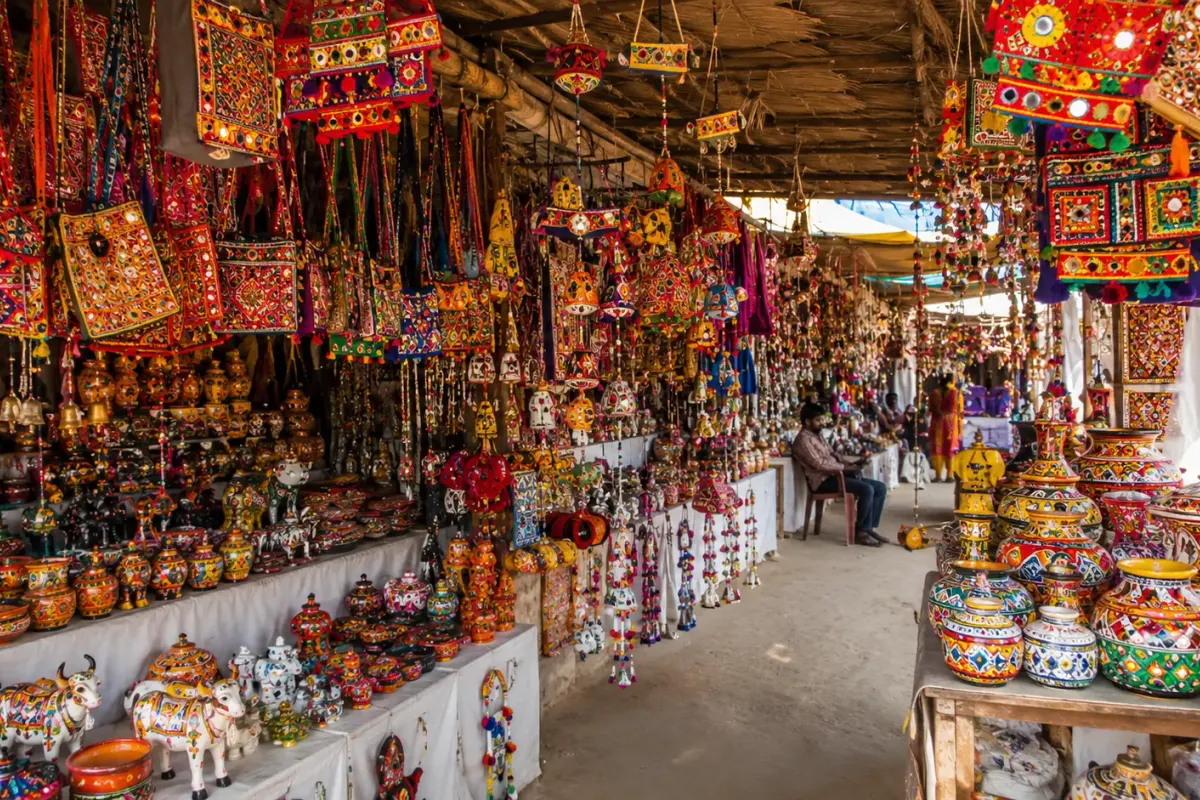
Rogan art, one of Kutch's most famous crafts, is practised by essentially one family on the entire planet roughly ten members of the Khatri clan in Nirona village, descendants of eight generations of the same tradition. Kutch handicrafts genuinely aren't a single souvenir category; they're a cluster of distinct, village-specific traditions, several on the edge of disappearing. This guide covers what each craft actually is, where to buy it authentically, what it should cost, and how to tell genuine work from the mass-produced imitations that fill generic tourist shops.
KUTCH HANDICRAFTS: AN OVERVIEW OF WHAT MAKES THIS REGION UNIQUE
Kutch handicrafts exist in this specific concentration for a genuine historical reason: successive waves of craftsperson communities settled across different Kutch villages over centuries, often after migrating from Sindh, Persia and other neighbouring regions, and each community's tradition stayed rooted in its specific settlement rather than spreading uniformly across the district. That's why Ajrakh printing, Rogan art, Bandhani and Bhujodi weaving each belong distinctly to their own villages rather than being interchangeable Kutch souvenirs.
This matters practically for buyers: the "where you buy it" question isn't just about convenience, it's about authenticity. A genuine piece bought directly from the practising community in its home village carries a different level of certainty than the same craft name printed on a factory-made item in a generic tourist shop.
ROGAN ART: THE CRAFT ONLY ONE FAMILY KEEPS ALIVE
Rogan art is Nirona village's signature craft, and it's genuinely rare in the truest sense practised almost exclusively by the Khatri family, led by Padma Shri awardee Abdul Gafur Khatri, whose clan has carried the tradition across roughly eight generations. Today only around ten family members actively continue the practice. The craft reportedly traces back 300-400 years, likely descended from Persian textile traditions.
The technique itself is genuinely unusual: castor oil is boiled and mixed with natural mineral pigments to create an oil-paint-like paste, then applied freehand to fabric using a metal stylus rather than a brush no pre-drawn pattern guides the artist, who works entirely from memory and skill. Designs are typically symmetrical, achieved by painting half the motif, then folding the fabric to transfer a mirror image onto the other half. The "Tree of Life" motif is Rogan art's best-known design, and its global reputation got a genuine boost in 2014, when Indian Prime Minister Narendra Modi gifted a Rogan art piece to then-US President Barack Obama the work now hangs in the White House.
kutch textile buyers specifically hunting for Rogan art should go directly to Nirona and buy from the Khatri family's own workshop or a clearly verified outlet, given how few genuine practitioners exist a piece labelled "Rogan art" from an unverified source elsewhere deserves real scepticism.
"Kutch Nahi Dekha To Kuch Nahi Dekha if you haven't seen Kutch, you haven't seen anything."
— Traditional Gujarati saying
AJRAKH PRINTING: A 400-YEAR KUTCH LINEAGE ON A 2,500-YEAR-OLD ART FORM
Ajrakh printing has a genuinely layered history worth understanding properly rather than compressing into one date. The art form itself is ancient some sources trace its printing and dyeing traditions back 2,500 to 5,000 years, with roots connected to the Indus Valley Civilisation. But the specific Kutch community practising it today arrived roughly 400 years ago, invited by Rao Bharmalji I and settling first in Dhamadka village before the craft spread to Ajrakhpur and Khavda as well.
The process genuinely earns its reputation for skill: a single piece of Ajrakh printing kutch fabric passes through 16 distinct stages, using entirely natural dyes drawn from indigo, henna, turmeric, pomegranate, iron and mud. The most reliable authenticity marker, and one most buyers never think to check, is that genuine hand-block-printed Ajrakh is printed on both sides of the fabric a distinctive double-sided result that mass-produced, machine-printed imitations don't replicate. In 2024, Kutch Ajrakh formally received a Geographical Indication (GI) tag from India's Controller General of Patents, Designs and Trademarks, official government recognition tying the craft specifically to this region.
Dr. Ismail Khatri's workshop in Ajrakhpur is among the most visited and internationally recognised, and the Living and Learning Design Centre nearby, run by Shrujan Trust, offers a museum and hands-on gallery specifically to help visitors understand and identify authentic work.
Craft | Authenticity Marker | Where to Verify Rogan art | Practised by essentially one family (Khatri clan, Nirona) | Buy directly at the Nirona workshop Ajrakh | Genuine hand-block-print is printed on both sides of the fabric | Ajrakhpur, Dhamadka, Khavda workshops; look for GI tag reference Bandhani | Hand-tied dots show natural, slightly irregular spacing; machine dots are too uniform | Bhuj artisan workshops, verified outlets
Planning Your Kutch Trip?
Contact our travel experts for personalized assistance and custom itineraries.
BANDHANI (BANDHEJ): KUTCH'S TIE-DYE TRADITION
Bandhani, known locally as Bandhej, is Kutch's tie-dye tradition, and the Bhuj-based version is specifically noted for its intricacy. Skilled artisans use a small needle-like attachment worn on the finger to lift and tie minuscule points of fabric often working through two or four folded layers at once, depending on the design's symmetry and fabric thickness before the piece goes through dyeing. A design graph is plotted onto the fabric first to guide exactly where each tie point goes, and cotton thread secures each tiny bound section before the dye is applied.
The result, once untied and unfolded, reveals the dot-pattern designs Bandhani is known for. Genuine hand-tied Bandhani shows natural, very slightly irregular dot spacing under close inspection a useful thing to check if you're comparing pieces, since machine-replicated "Bandhani-print" fabric produces suspiciously perfect, uniform dot grids instead.
KUTCH EMBROIDERY: NOT ONE STYLE, BUT AT LEAST FIVE
Kutch embroidery content online overwhelmingly treats this as a single craft category, which genuinely undersells what's actually happening across the district. At minimum, five distinct embroidery styles are practised across different Kutch communities: Suf, Khaarek, Paako, Rabari and Mutava each with its own stitch technique, motif style and community lineage, taking anywhere from several weeks to several months to complete a single elaborate piece.
The Living and Learning Design Centre in Ajrakhpur runs a dedicated museum that has researched and catalogued more than 40 embroidery styles, not just from Kutch itself but from neighbouring regions including Iran, Afghanistan and Pakistan genuinely the most comprehensive single resource for understanding how these traditions relate to each other. If distinguishing embroidery styles matters to your purchase, this museum is worth visiting before you start shopping, not after.
WHERE TO BUY AUTHENTIC KUTCH HANDICRAFTS
Buy handicrafts kutch travellers trust most comes down to buying directly from the practising village rather than a generic city shop. Bhujodi, roughly 8 km from Bhuj, is the most accessible starting point and home to the Vankar weaving community, alongside the Hiralaxmi Memorial Craft Park a single complex bringing artisans from across Kutch together under one roof, genuinely useful if your time is limited. Ajrakhpur, about 15 km from Bhuj, centres on Ajrakh block printing, while Nirona, roughly 40-45 km north, is the place for Rogan art, hand-shaped copper bells, and lacquer work.
Beyond the individual villages, Khamir, a not-for-profit based in Kukma village, provides a platform promoting Bandhani, pottery, block printing, kala cotton and other Kutch crafts collectively, useful if you want a curated overview in one visit rather than a multi-village day trip.
Village | Distance from Bhuj | Primary Craft Bhujodi | ~8 km | Vankar handloom weaving, multi-artisan craft park Ajrakhpur | ~15 km | Ajrakh block printing Nirona | ~40-45 km | Rogan art, copper bells, lacquer work Kukma (Khamir) | Varies, check locally | Curated multi-craft platform
HOW TO SPOT AUTHENTIC VS FAKE
This is the section most kutch handicrafts guides skip entirely, and it matters more than most buyers realise given how much mass-produced "Kutch-style" product circulates in generic tourist markets. For Ajrakh specifically, check both sides of the fabric genuine hand-block work is printed on both faces, not just one. For Bandhani, look closely at dot spacing; hand-tied work shows natural, slightly imperfect spacing, while machine-replicated prints look suspiciously uniform. For Rogan art, given how few genuine practitioners exist, buying directly from Nirona's Khatri family workshop is the single most reliable verification available.
More broadly, ask who made the piece and where. Genuine artisans and reputable outlets the LLDC, Khamir, and established village workshops are generally happy to explain their process; vague or evasive answers about sourcing are a real warning sign.
COST OF KUTCH HANDICRAFTS
Here's a realistic price range for common Kutch handicraft purchases, based on current retail listings from established Kutch craft sellers.
Item | Budget | Mid-Range | Luxury Ajrakh dupatta | ₹1,700-2,650 | ₹3,250-5,200 | ₹8,000-15,500 (silk blends, elaborate borders) Bandhani dupatta/stole | ₹2,000-3,900 | ₹4,500-7,800 | ₹15,000-44,000 (elaborate designer sarees) Bhujodi handwoven shawl | ₹3,200-5,000 | ₹5,000-8,500 | ₹8,500-10,500 (pure wool, silk embellishments) Rogan art piece | Price on request | Price on request | Price on request (varies significantly by size and complexity; confirm directly with the Nirona workshop)
Prices as of Month 3 (October 2026), built from current listings on established Kutch craft retail platforms verify current pricing directly with artisans or outlets before buying, since handmade work genuinely varies piece to piece.
SUGGESTED CRAFT VILLAGE CIRCUIT
A well-planned single-day route covers Bhujodi, Ajrakhpur and Nirona without excessive backtracking: start in Bhuj for Ajrakh and Bandhani workshops, continue to Bhujodi for weaving, then head north to Nirona for Rogan art, copper bells and lacquer work. Given the distances involved particularly the roughly 40-45 km stretch to Nirona budget a genuine full day rather than trying to rush all three villages into a half-day add-on to other Kutch sightseeing.
13 PRACTICAL TIPS FOR BUYING KUTCH HANDICRAFTS
1. Buy Rogan art directly from Nirona's Khatri family workshop or a clearly verified outlet, given how few genuine practitioners exist worldwide.
2. Check both sides of Ajrakh fabric before buying genuine hand-block-printed work is printed on both faces.
3. Look closely at Bandhani dot spacing; natural, slightly irregular ties indicate genuine handwork.
4. Visit the Living and Learning Design Centre in Ajrakhpur before shopping if you want to properly distinguish between the five-plus Kutch embroidery styles.
5. Budget a full day for the Bhujodi-Ajrakhpur-Nirona circuit rather than rushing it as a half-day stop.
6. Ask artisans directly about their process and sourcing; reputable sellers are generally happy to explain, evasive answers are a warning sign.
7. Carry cash for smaller village workshops, where card payment isn't always reliable.
8. Visit the Hiralaxmi Memorial Craft Park in Bhujodi if your time is limited, since it brings multiple artisan traditions together under one roof.
9. Don't assume higher price automatically means more authentic ask specifically about materials (natural versus synthetic dyes, hand-tied versus machine-replicated) rather than judging by cost alone.
10. Bargain respectfully at village workshops, but recognise that genuinely handmade, skill-intensive pieces have real labour and material costs behind their pricing.
11. If buying Bandhani or Ajrakh sarees specifically, factor in that elaborate silk-blend or designer-border pieces can run into the tens of thousands of rupees budget accordingly if that's your target.
12. Combine your craft village visit with Rann Utsav dates rather than treating it as a separate trip, since Bhujodi and Ajrakhpur sit conveniently between Bhuj and Dhordo.
13. Ask about care instructions for natural-dye pieces specifically, since Ajrakh and Bandhani items with natural dyes often need gentler washing than synthetic-dye equivalents.
FREQUENTLY ASKED QUESTIONS
What are the main Kutch handicrafts? Rogan art, Ajrakh block printing, Bandhani tie-dye, and at least five distinct embroidery styles (Suf, Khaarek, Paako, Rabari, Mutava), alongside Bhujodi handloom weaving, copper bell making and lacquer work.
Where can I buy authentic Rogan art? Directly from Nirona village, ideally from the Khatri family workshop itself, since Rogan art is practised by essentially one family roughly ten members of the same clan worldwide.
Does Kutch Ajrakh have a GI tag? Yes. Kutch Ajrakh received official Geographical Indication recognition in 2024 from India's Controller General of Patents, Designs and Trademarks, formally tying the craft to this specific region.
How can I tell if Ajrakh fabric is genuine? Check both sides of the fabric. Authentic hand-block-printed Ajrakh is printed on both faces, a distinctive result that machine-printed imitations don't replicate.
How many types of Kutch embroidery are there? At least five major styles are documented Suf, Khaarek, Paako, Rabari and Mutava each with distinct stitch techniques and community origins, though a dedicated Ajrakhpur museum has catalogued over 40 related styles from Kutch and neighbouring regions.
How far are the craft villages from Bhuj? Bhujodi is roughly 8 km, Ajrakhpur about 15 km, and Nirona roughly 40-45 km, making a combined single-day circuit genuinely feasible from Bhuj.
Is it worth buying Kutch handicrafts directly from artisan villages versus city shops? Yes, generally. Buying directly gives you a clearer sense of authenticity and process, and supports the specific artisan communities keeping these traditions alive, though verified outlets like the Living and Learning Design Centre and Khamir also offer reliable, curated options.
FINAL VERDICT: IS A KUTCH HANDICRAFTS TRIP WORTH IT?
Yes, genuinely, if you care about craftsmanship beyond a standard souvenir purchase. Few places in India let you buy directly from a Padma Shri-honoured artisan family practising a technique with fewer than a dozen living practitioners, or watch a 2,500-year-old printing tradition still being hand-worked in the village where it settled 400 years ago. Building a dedicated craft-village day into your Kutch trip adds a dimension most Rann Utsav-only itineraries never touch.
It's less essential if you're genuinely tight on time and shopping isn't a priority a rushed 20-minute stop at each village undersells what's actually happening in these workshops. Give it a real day, or skip it in favour of other Kutch sights and buy from verified outlets like Khamir or the LLDC instead.
About the author: This guide was compiled by the IVARA Journeys travel team, who curate premium and pilgrimage travel packages across Gujarat, including dedicated Kutch craft-village circuits. Last visited Kutch: October 2026.
Ready to build a craft village day into your Kutch trip? Talk to our Kutch travel expert (/contact) or explore our Rann Utsav packages (/packages/rann-utsav-kutch) and for deeper dives into specific villages, our bhujodi village and nirona village guides cover each craft hub in detail, alongside our homestay in kutch guide if you want to stay overnight in the region.
Ready to Experience This?