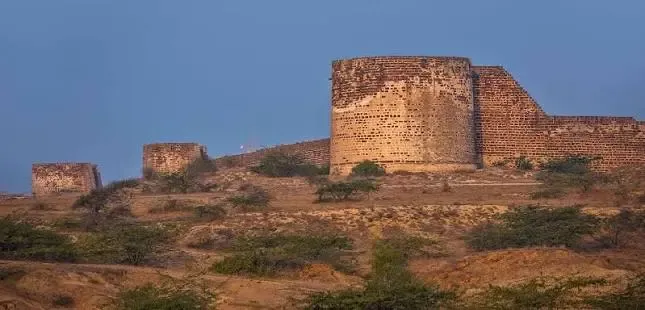
Lakhpat Fort held roughly 15,000 residents in 1818, generating enough trade revenue to make the town genuinely wealthy. By the 2011 census, only 566 people remained across 108 households. Lakhpat fort is one of the more haunting places to visit in kutch offbeat travellers actively seek out, and this guide covers exactly how a thriving port collapsed into a ghost town, what's still standing inside its walls, and whether the long drive out here is worth it.
THE HISTORY OF LAKHPAT FORT: FROM BOOMTOWN TO GHOST TOWN
Lakhpat kutch takes its name, by popular local account, from the roughly one lakh kauris — the old currency of the Kutch state — that the town's maritime trade generated in daily revenue at its peak. The fort itself, its walls stretching a full 7 kilometres and standing up to 20 feet tall in places, was constructed in 1801 under Jamadar Fateh Muhammad, built specifically to protect a genuinely prosperous port town from invasion, with a toll gate once used to tax merchants along an important 18th-century trade route.
Everything changed in 1819. An earthquake estimated above magnitude 8 struck Kutch, and beyond the immediate destruction, it permanently diverted the Indus River away from Lakhpat, cutting the town off from the waterway its entire economy depended on. The population collapsed from roughly 15,000 in 1818 to about 6,000 the following year, and the decline never fully reversed. A partial recovery did happen in the 1930s and 1940s, when Lakhpat was elevated to taluka status with new warehouses, a school and a library — but 1947 Partition delivered the final blow, severing the centuries-old trade and cultural ties between Kutch and Sindh and putting the recovering Bibidullah port permanently out of reach due to its new proximity to an international border. By the 2011 census, just 566 people remained.
WHAT'S INSIDE LAKHPAT FORT
Despite the population collapse, Lakhpat fort remains genuinely significant as a place of pilgrimage and quiet religious coexistence. The lakhpat gurudwara, formally known as Gurudwara Pehli Patshahi, commemorates Guru Nanak's visits to the town during two of his four great journeys, or Udasis, undertaken in the early 16th century. The Gurudwara preserves rare personal relics associated with the Guru, including wooden footwear known as Charan Paduka, and continues to offer simple accommodation to Sikh pilgrims and travellers alike.
Right beside the Gurudwara sits the tomb of Pir Ghaus Muhammad, a Sufi mystic who died in 1855 and who practised both Hindu and Islamic religious traditions during his life — a detail that makes his black-stone, octagonal tomb, capped with a white marble canopy inscribed with Quranic verses, a genuine symbol of the religious harmony this abandoned town still quietly represents. Other structures worth seeking out include the nine-domed Sayyed Pir Shah Dargah, the Nani Mai Dargah, and the Hatkeshwar Temple — together, a cluster of Hindu, Muslim and Sikh sites coexisting within the same crumbling fort walls.
Structure | Significance Gurudwara Pehli Patshahi | Commemorates Guru Nanak's visits during two Udasis; preserves his relics Tomb of Pir Ghaus Muhammad | Sufi saint's shrine, revered across religious lines Sayyed Pir Shah Dargah | Nine-domed mausoleum Hatkeshwar Temple | Hindu temple within the fort complex
"Kutch Nahi Dekha To Kuch Nahi Dekha — if you haven't seen Kutch, you haven't seen anything."
— Traditional Gujarati saying
HOW TO REACH LAKHPAT FORT
Lakhpat sits roughly 134 km from Bhuj, and this is genuinely a long, remote drive — expect the journey itself to take a significant chunk of your day, passing through increasingly sparse stretches of western Kutch as you approach the coast near Kori Creek. Fuel stations and food stops thin out considerably compared to the Bhuj-Dhordo corridor, so plan accordingly.
Given the distance, most visitors combine Lakhpat with Narayan Sarovar and Koteshwar Temple, both sitting reasonably close by on Kutch's western edge, rather than treating it as a standalone day trip. This cluster forms a genuinely quiet, uncrowded circuit compared to the rest of Kutch's tourist trail.
Planning Your Kutch Trip?
Contact our travel experts for personalized assistance and custom itineraries.
BEST TIME TO VISIT LAKHPAT
October through February remains the practical window, consistent with the rest of Kutch, both for comfortable daytime temperatures and for road conditions on the longer drive out. One detail worth knowing specifically: Lakhpat's remote location and genuinely clear desert air make it a notable stargazing spot after dark, with visits timed near the new moon offering the best night-sky viewing if that interests you.
Sunrise and sunset from the fort walls are both worth building time around — the endless horizon here, with the Rann stretching out on one side and Kori Creek on the other, is a genuinely different visual experience from anywhere else in Kutch.
COST OF VISITING LAKHPAT FORT
Here's a realistic cost breakdown for a Lakhpat excursion, per person.
Category | Budget | Mid-Range | Luxury Entry to fort/structures | Free (no formal entry fee reported) | Free | Free Transport from Bhuj (round trip, shared) | ₹2,000-3,000 | N/A | N/A Private cab from Bhuj (round trip) | N/A | ₹6,000-8,500 | ₹10,000-13,000 (SUV) Overnight stay (Gurudwara accommodation or guesthouse) | Donation-based (Gurudwara) or ₹800-1,500 | ₹1,500-3,000 | Limited luxury options; combine with a Narayan Sarovar/Koteshwar circuit stay
Prices as of Month 3 (October 2026), built from typical Kutch long-distance cab rates and general guesthouse pricing — verify current transport costs before travelling, since this is a genuinely remote route with fewer operators than the main Bhuj-Dhordo corridor.
11 PRACTICAL TIPS FOR VISITING LAKHPAT FORT
1. Treat this as a full-day excursion at minimum, given the roughly 134 km distance from Bhuj and the genuinely remote road conditions.
2. Combine your visit with Narayan Sarovar and Koteshwar Temple, both nearby, rather than making the long drive for Lakhpat alone.
3. Fill your fuel tank in Bhuj before setting out; stations thin out considerably on this route.
4. Carry more water and snacks than usual, since food stops are genuinely sparse on the way to Lakhpat.
5. Climb the northern ramparts specifically for the best Rann views, and note how dramatically different the landscape looks depending on the season.
6. Respect the Gurudwara's active religious function — it remains a working place of worship, not just a historic monument.
7. If interested in stargazing, plan your visit around the new moon for the clearest night sky.
8. Carry a physical photo ID, given the region's proximity to the India-Pakistan border.
9. Mobile network coverage is genuinely unreliable in this remote stretch of western Kutch — download offline maps before you set out.
10. Wear sturdy, closed shoes for walking the fort's uneven, largely unrestored terrain.
11. If you want to experience Gurudwara accommodation, contact them ahead rather than assuming availability on arrival, since it operates on a hospitality basis rather than a formal booking system.
FREQUENTLY ASKED QUESTIONS
Why is Lakhpat Fort called a ghost town? Lakhpat's population collapsed from roughly 15,000 residents in 1818 to about 6,000 the following year after an 1819 earthquake diverted the Indus River away from the town, ending its role as a port. Today, only around 566 people remain, per the 2011 census.
What is inside Lakhpat Fort? The Gurudwara Pehli Patshahi, commemorating Guru Nanak's visits; the tomb of Sufi saint Pir Ghaus Muhammad; the nine-domed Sayyed Pir Shah Dargah; and the Hatkeshwar Temple all sit within the fort's 7 km walls, representing a genuine cluster of religious coexistence.
Why is the Lakhpat Gurudwara significant? It commemorates Guru Nanak's visits to the town during two of his four great journeys, or Udasis, in the early 16th century, and it preserves rare relics associated with him, including wooden footwear known as Charan Paduka.
How far is Lakhpat Fort from Bhuj? Approximately 134 km, a genuinely long and remote drive through increasingly sparse western Kutch. Most visitors combine it with nearby Narayan Sarovar and Koteshwar Temple rather than visiting alone.
What caused Lakhpat's decline? An 1819 earthquake, estimated above magnitude 8, diverted the Indus River away from the town, ending its port trade. A partial 1930s-40s recovery was then reversed by 1947 Partition, which cut Lakhpat off from its remaining trade route with Sindh.
Is Lakhpat Fort worth visiting? Yes, particularly for travellers interested in offbeat history and quiet, uncrowded sites — but only if you have the time for a genuinely long round trip. It's not a quick add-on to a standard Rann Utsav itinerary given the distance involved.
Can I stay overnight at Lakhpat? Yes. The Gurudwara offers simple accommodation to travellers on a hospitality basis, and a small number of local guesthouses exist, though options are genuinely limited compared to Bhuj or Dhordo.
FINAL VERDICT: IS LAKHPAT FORT WORTH THE DETOUR?
Yes, if offbeat history and a genuinely different Kutch experience matter to you more than ticking off the standard Rann Utsav circuit. The population-collapse story alone, backed by real census numbers, makes Lakhpat one of the most quietly compelling places to visit in kutch offbeat travellers can add to a longer itinerary, and the religious-coexistence angle at the Gurudwara and Pir Ghaus Muhammad's tomb is genuinely moving in person.
Skip it on a short 2-3 day trip built around Dhordo and Bhuj — the 134 km distance and remote road conditions demand real time you likely don't have on a rushed schedule. Save it for a 6-7 day Kutch itinerary or a dedicated return visit, ideally combined with Narayan Sarovar and Koteshwar on the same day.
About the author: This guide was compiled by the IVARA Journeys travel team, who curate premium and pilgrimage travel packages across Gujarat, including offbeat western Kutch circuits. Last visited Kutch: October 2026.
Ready to add Lakhpat to a longer Kutch itinerary? Talk to our Kutch travel expert (/contact) or explore our Rann Utsav packages (/packages/rann-utsav-kutch) — and for the full list of 35 best places across Kutch district, our kutch tourism guide and best time to visit kutch guide help you plan the complete trip, alongside our bhuj tourist places guide for the city you'll likely pass through en route.
Ready to Experience This?