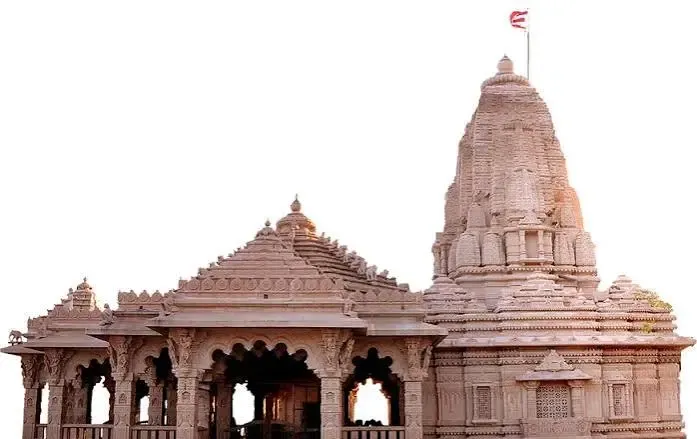
Search for the distance to Mata no Madh from Bhuj and you'll find answers ranging from 77 km to 138 km, depending on which travel site you trust a genuinely unusual spread for a single, well-established pilgrimage route. Mata no madh is the seat of Ashapura Mata, patron goddess of the Jadeja rulers of Kutch, and this guide sorts out the real distance, the temple's actual history, and exactly when to time your visit around its biggest festival.
WHAT IS MATA NO MADH? THE ASHAPURA MATA LEGEND
Mata no madh temple literally translates to "the abode of the Mother," and it houses one of Kutch's most significant shrines, dedicated to Ashapura Mata a name built from "asha" (hope) and "pura" (fulfil), the goddess who fulfils hopes and wishes. She's worshipped as the kuldevi, or family deity, of the Jadeja Rajputs who once ruled Kutch, and countless Kutchi families across India and abroad continue to revere her in that same role today. She's also known locally as Desh Devi, the Goddess of the People, and some traditions regard her as an incarnation of Annapoorna Devi.
The temple's founding legend is genuinely specific and still repeated today: roughly 1,500 years ago, a Marwar-based devotee named Devchand, seeking a child, was instructed in a dream to build a shrine at the spot where he had spent Navratri in devotion. Following the goddess's guidance, he discovered a coconut and a red cloth as confirming signs. According to the story, the temple doors were meant to remain closed for six months, but Devchand opened them early and witnessed the deity in the kneeling position she's still depicted in today.
HISTORY AND CONSTRUCTION: A GENUINE SOURCE DISAGREEMENT
This is worth addressing directly rather than picking one version and presenting it as settled. Some sources date the original temple construction to the 14th century, attributed to Ajo and Anagor, ministers serving Lakho Phulani. Others describe a temple structure roughly 1,200 years old, and separately note that references to this goddess appear in the Puranas and the Rudrayamal Tantra, with firm evidence that the deity was already established here by the 9th century AD, when the Samma clan of Rajputs first entered northwestern Kutch. These accounts don't fully align, and rather than force a single timeline, it's more honest to say the site's worship likely predates its earliest confirmed structure by a significant margin.
What's consistent across sources is the temple's more recent history of destruction and rebuilding. The 1819 earthquake damaged the structure significantly, and it was reconstructed in 1823 by Sundarji Shivji and Mehta Vallabhaji of the Brahma Kshatriya community. The 2001 Bhuj earthquake caused further damage, and the temple was restored once again afterward meaning what you'll see today reflects at least two significant post-earthquake rebuilds layered onto a site with genuinely ancient religious roots.
"Kutch Nahi Dekha To Kuch Nahi Dekha if you haven't seen Kutch, you haven't seen anything."
— Traditional Gujarati saying
INSIDE THE TEMPLE COMPLEX
Kutch temple architecture here follows a pattern seen elsewhere in the district Mata no Madh isn't a single shrine but a complex, housing additional sites dedicated to Lord Shiva, Hinglaj Mata, Chachra Bhawani, Khatla Bhawani and Jagora Bhawani alongside the main Ashapura Mata sanctum. The main idol depicts the goddess with multiple arms, dressed in rich red garments and ornaments, in the kneeling posture tied to the temple's founding legend.
The temple and its associated Kapadi religious order are led by a Mahant, locally referred to as "Raja," a role with a long-standing following in the village. The Shri Matana Madh Jagir Trust manages the site's day-to-day operations, including a gaushala (cow shelter) and various education-related community activities, alongside accommodation and meal arrangements for visiting pilgrims.
MATA NO MADH TIMINGS AND NAVRATRI FESTIVAL
Regular darshan timings follow the general pattern of Hindu temples across Kutch, though the temple's real character shows during Ashvin Navratri, typically falling in October, when the entire site transforms. During these nine nights, darshan runs an extended window from 5:00 AM to 1:00 AM, ghat sthapana takes place the day before the festival begins, and a large-scale havan is held on Ashtami. Folk singers perform each night, drawing both locals and travellers into the celebration.
The most striking Navratri tradition is the pad yatra a barefoot pilgrimage undertaken by lakhs of devotees converging on the temple on foot, with volunteer camps set up along the route offering food, water and rest to walkers. Special buses also run from Bhuj during this period specifically to handle the surge in visitor numbers. If you want the temple at its most vivid, Navratri delivers that; if you want a quiet, contemplative visit, avoid it, since this is genuinely the site's peak crowd period.
Planning Your Kutch Trip?
Contact our travel experts for personalized assistance and custom itineraries.
HOW TO REACH MATA NO MADH
This is where the numbers genuinely stop agreeing. Distance from Bhuj is quoted as low as 77 km by one source and as high as 138 km by another, with most sources clustering somewhere between 90 km and 110 km. Given this spread, treat any single figure with caution and budget a full 2 to 2.5-hour drive at minimum, potentially longer, rather than planning around an optimistic low-end number.
Mata no madh kutch sits in Lakhpat Taluka, which means it combines naturally with the other western Kutch sites covered elsewhere in this series Narayan Sarovar, Koteshwar Temple and Lakhpat Fort all sit within a reasonable driving distance of each other, and most operators package them together as a single spiritual and heritage circuit rather than separate trips. If you're already planning a visit to lakhpat fort or vijay vilas palace and mandvi beach kutch as part of a longer western Kutch itinerary, Mata no Madh fits naturally into that same extended route.
Distance Estimate | Source Range Lowest reported | 77 km Most commonly cited | 90-110 km Highest reported | 138 km
COST OF VISITING MATA NO MADH
Here's a realistic cost breakdown for visiting Mata no Madh, per person.
Category | Budget | Mid-Range | Luxury Temple entry | Free | Free | Free Transport from Bhuj (round trip, shared) | ₹2,000-3,000 | N/A | N/A Private cab from Bhuj (round trip) | N/A | ₹5,500-7,500 | ₹9,000-12,000 (SUV) Prasad/offerings | ₹50-150 | ₹150-400 | ₹400+ Combined western Kutch circuit (Lakhpat, Narayan Sarovar, Koteshwar) | ₹4,000-6,000 total | ₹10,000-14,000 total | ₹16,000-20,000 total
Prices as of Month 4 (November 2026), built from typical long-distance Kutch cab rates verify current transport costs before travelling, and expect significantly higher demand and pricing if visiting during Navratri specifically.
12 PRACTICAL TIPS FOR VISITING MATA NO MADH
1. Don't plan your day around the lowest quoted distance figure budget a full 2 to 2.5-hour drive minimum given how widely sources disagree.
2. Combine your visit with Lakhpat Fort, Narayan Sarovar and Koteshwar Temple, all within the same western Kutch region, rather than making a separate trip.
3. Avoid visiting during Navratri if you want a quiet, uncrowded experience this is genuinely the temple's peak period.
4. If you do want the Navratri experience specifically, plan around the nine-night Ashvin festival in October and expect extended 5:00 AM-1:00 AM darshan hours.
5. Dress modestly and respectfully; this remains an active, working place of worship, not a historic monument.
6. Carry cash for prasad and small offerings; card payment options are unreliable at a site this remote.
7. Fill your fuel tank in Bhuj before setting out, given the genuinely long drive and sparse fuel stops along the way.
8. Check whether special buses are running from Bhuj if you're visiting during Navratri specifically, as an alternative to arranging private transport during the festival's peak crowds.
9. Mobile network coverage is unreliable on the approach to Mata no Madh download offline maps before setting out.
10. If travelling with a mixed-faith group, know that this is a genuinely inclusive pilgrimage site welcoming Hindu, Jain and Muslim visitors alike.
11. Ask locally about accommodation through the Shri Matana Madh Jagir Trust if you want to stay overnight rather than making the return drive the same day.
12. Treat this as part of a full-day or overnight western Kutch circuit rather than a quick standalone stop, given the distance involved.
FREQUENTLY ASKED QUESTIONS
What is Mata no Madh famous for? It houses the Ashapura Mata Temple, the kuldevi (family deity) of the Jadeja rulers of Kutch and patron goddess of the wider Kutchi community, with a founding legend dating back roughly 1,500 years.
How far is Mata no Madh from Bhuj? Sources genuinely disagree, ranging from 77 km to 138 km, with most citing 90-110 km. Budget a 2 to 2.5-hour drive at minimum given this spread.
What is the legend behind Ashapura Mata Temple? A devotee named Devchand, seeking a child roughly 1,500 years ago, was instructed in a dream to build a shrine where he had spent Navratri. He found a coconut and red cloth as confirming signs, and opened the temple early, seeing the goddess in the kneeling posture she's still depicted in today.
When is the best time to visit Mata no Madh? October through February for pleasant weather generally, or specifically during Ashvin Navratri in October if you want the temple at its most vibrant, though this is also the peak crowd period.
Is there an entry fee for Mata no Madh Temple? No, entry is free. As an active place of worship, modest and respectful attire is expected of all visitors.
What is the pad yatra at Mata no Madh? A barefoot pilgrimage undertaken by lakhs of devotees during Navratri, walking to the temple with volunteer camps along the route providing food, water and rest.
Can I combine Mata no Madh with other western Kutch sites? Yes, and it's strongly recommended. Mata no Madh sits in Lakhpat Taluka, close enough to Lakhpat Fort, Narayan Sarovar and Koteshwar Temple to combine all four into one extended western Kutch circuit.
FINAL VERDICT: IS MATA NO MADH WORTH THE VISIT?
Yes, particularly if you're already building a western Kutch pilgrimage circuit around Lakhpat Fort, Narayan Sarovar and Koteshwar Temple Mata no Madh completes that route with genuine religious significance rather than just another heritage stop. The founding legend, the multi-community reverence, and the sheer scale of the Navratri pad yatra all make this a site worth understanding properly rather than rushing through.
Skip a dedicated single-purpose trip here if your Kutch itinerary is short the distance, however you measure it, is genuinely significant, and it makes far more sense as part of a combined western Kutch day than a standalone visit from Bhuj.
About the author: This guide was compiled by the IVARA Journeys travel team, who curate premium and pilgrimage travel packages across Gujarat, including western Kutch temple circuits. Last visited Kutch: November 2026.
Ready to add Mata no Madh to your western Kutch circuit? Talk to our Kutch travel expert (/contact) or explore our Rann Utsav packages (/packages/rann-utsav-kutch) and for the rest of this region, our lakhpat fort guide, vijay vilas palace guide and mandvi beach kutch guide help you plan the complete trip.
Ready to Experience This?