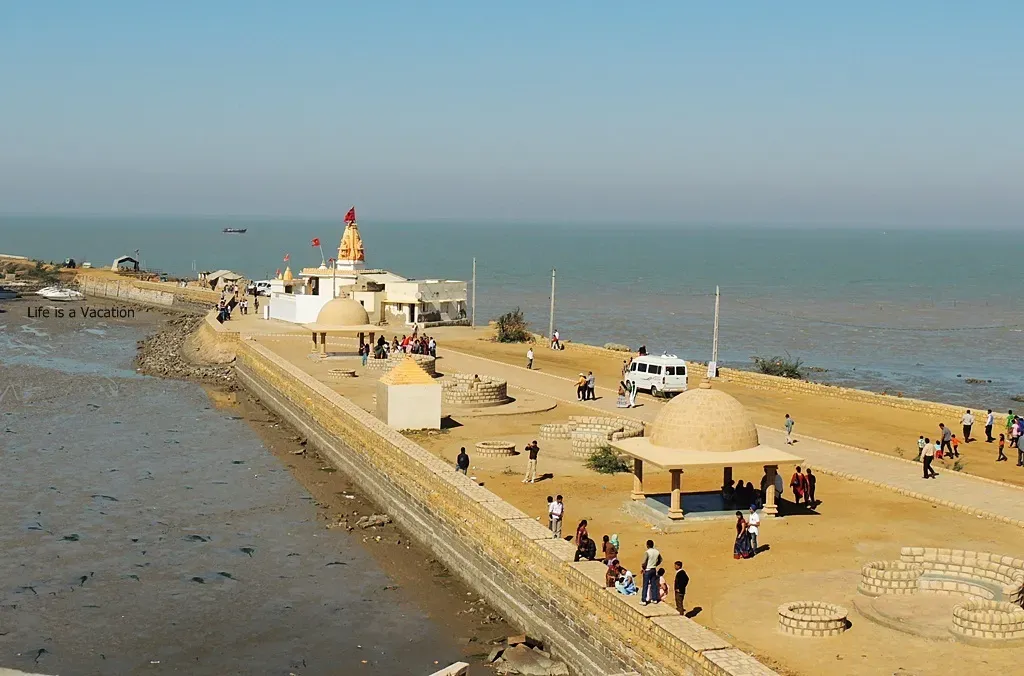
A 7th-century Chinese traveller named Hieun-Tsiang wrote about this stretch of Kutch coast roughly 1,300 years before anyone had heard of Rann Utsav, describing a harbour ringed by nearly 80 monasteries. Narayan sarovar and the neighbouring Koteshwar Temple sit at India's literal westernmost inhabited edge, and this guide covers the real history, the practical logistics, and an honest account of the genuinely long drive out here.
NARAYAN SAROVAR: ONE OF HINDUISM'S FIVE SACRED LAKES
Narayan sarovar kutch holds a genuinely rare religious status it's one of the Panch Sarovar, the five sacred lakes of Hinduism named in the Shrimad Bhagavata Purana, alongside Mansarovar in Tibet, Bindu Sarovar in Gujarat, Pampa Sarovar near Hampi, and Pushkar Sarovar in Rajasthan. According to tradition, the sacred Saraswati River once had an outlet into the sea near this exact spot, filling the lake with holy water the specific reason this location earned its place among the five.
The temple complex itself comprises seven stone shrines within a paved courtyard measuring roughly 164 by 62.5 feet, reached from the lake by stone steps and enclosed by a protective wall. Two of the most significant structures, the Lakshminarayan and Trikamray temples, were built in 1734 in the same architectural style as the temples at Dwarka the Trikamray temple alone measures 72 feet long, 68.5 feet wide and 61 feet high. The site also functions as a Pitru Tirtha, where devotees perform rituals for departed ancestors, adding another layer of pilgrimage significance beyond the lake itself.
KOTESHWAR TEMPLE: THE WESTERNMOST POINT OF INDIA
Koteshwar temple sits roughly 2-4 km further from Narayan Sarovar (sources give slightly different distances), perched directly at the edge of the Arabian Sea at what's genuinely the westernmost inhabited point of the Indian subcontinent. The name Koteshwar translates roughly to "ten million gods," and local legend holds that Lord Shiva granted a spiritually powerful lingam to Ravana in recognition of his devotion a story that connects this remote temple to one of Hindu mythology's most recognisable figures.
The temple's documented history runs genuinely deep. The 7th-century Chinese traveller Hieun-Tsiang described this area as a significant harbour featuring approximately 80 monasteries, situated about 5 miles from the mouth of the Indus River a reference that places this site on record more than 1,300 years before the current structure existed. The present temple building itself dates to 1820, built by Jetha Shivji Brahmashaktirya and Seth Sundarji according to inscriptions at the entrance. Today, it's genuinely the only constructed point where the calm Arabian Sea meets Kutch's stark desert terrain, and sunset views from the temple are consistently described as spectacular.
Site | Key Fact | Significance Narayan Sarovar | One of 5 Panch Sarovar lakes, 7 temples, built 1734 | Major Hindu pilgrimage site, Pitru Tirtha Koteshwar Temple | Built 1820, documented since the 7th century CE | India's westernmost inhabited point, Shiva-Ravana legend
"Kutch Nahi Dekha To Kuch Nahi Dekha if you haven't seen Kutch, you haven't seen anything."
— Traditional Gujarati saying
TIMINGS AND HOW TO REACH
This is genuinely one area where sources disagree meaningfully, so treat the following as a reasonable range rather than a fixed schedule. Temple timings across most sources run roughly 6:00 AM to 1:00 PM, reopening from 4:00 PM to somewhere between 8:00 PM and 9:00 PM, with the site closing to visitors after evening aarti. Plan your arrival either well before the midday closure or after the afternoon reopening, since showing up during the closed window wastes real travel time on a route this long.
Distance from Bhuj also varies by source, ranging from roughly 140 km up to 165 km, translating to 3.5 to 5 hours of driving depending on the exact route and whether you're going via Naliya. Roads are generally good but genuinely quiet one account describes "few vehicles" passing through this stretch, so this isn't a route to attempt with an empty fuel tank or low water supplies. Many visitors combine the drive with a stop at Mata no Madh temple, roughly on the way from Bhuj.
Route | Distance | Approx. Time Bhuj to Narayan Sarovar | 140-165 km (sources vary) | 3.5-5 hours Narayan Sarovar to Koteshwar | 2-4 km | 10-15 minutes Nearest airport | Bhuj (Rudra Mata Airport) | Same distance as above Nearest railway station | Bhuj Railway Station | Same distance as above
Planning Your Kutch Trip?
Contact our travel experts for personalized assistance and custom itineraries.
THE WILDLIFE SANCTUARY CONNECTION
Worth knowing honestly rather than glossing over: the Narayan Sarovar Chinkara Sanctuary, established in 1981 to protect the Indian gazelle and surrounding scrub habitat, was denotified in 1995 with its protected area significantly reduced to allow commercial mining. What remains covers roughly 444 square kilometres of scrub forest, desert thorn forest, dry savannah vegetation and seasonal wetlands. Visitors can still explore parts of the sanctuary with prior permission, particularly for birdwatching, but it's a genuinely diminished conservation area compared to its original 1981 designation a detail most tourism content around this site simply doesn't mention.
BEST TIME TO VISIT
October through March is the practical window, consistent with the rest of Kutch, avoiding both the region's punishing summer heat and monsoon-season travel difficulties. Pilgrimage traffic increases noticeably around festivals like Diwali, Kartik Purnima and Janmashtami, so expect thicker crowds and busier accommodation around these dates specifically.
If you're building a longer Kutch itinerary, this pairs naturally with Lakhpat Fort and Mata no Madh temple as a quiet, uncrowded western Kutch circuit, distinctly different from the busier Rann Utsav corridor around Dhordo.
COST OF VISITING NARAYAN SAROVAR AND KOTESHWAR
Here's a realistic cost breakdown per person for this excursion.
Category | Budget | Mid-Range | Luxury Temple entry | Free | Free | Free Wildlife sanctuary access (if visiting, nominal fee) | ₹50-100 | ₹100-200 | ₹200-500 (guided visit) Transport from Bhuj (round trip, shared) | ₹2,500-3,500 | N/A | N/A Private cab from Bhuj (round trip) | N/A | ₹7,000-9,500 | ₹11,000-14,000 (SUV) Overnight stay (Dharamshala or guesthouse) | Donation-based or ₹500-1,000 | ₹1,500-2,500 | Limited options; combine with a wider western Kutch circuit stay
Prices as of Month 4 (November 2026), built from typical Kutch long-distance cab rates and general accommodation costs for this remote route verify current fares before travelling, given how few operators serve this stretch compared to the main Bhuj-Dhordo corridor.
12 PRACTICAL TIPS FOR VISITING NARAYAN SAROVAR AND KOTESHWAR
1. Time your arrival before the midday temple closure (around 1:00 PM) or after the afternoon reopening (around 4:00 PM) don't plan around the closed window.
2. Treat this as a full-day excursion given the genuine 3.5-5 hour drive each way from Bhuj.
3. Fill your fuel tank in Bhuj before setting out; this is a genuinely remote route with few fuel stops along the way.
4. Carry more water and snacks than you think you'll need, since reliable food options outside the temple's own donation-based meals are limited.
5. Combine your visit with Lakhpat Fort and Mata no Madh temple for a fuller western Kutch pilgrimage circuit rather than a single-site day trip.
6. Watch sunset specifically from Koteshwar Temple the sea-meets-desert view is consistently described as one of the best in Kutch.
7. If you're interested in the Chinkara Sanctuary, arrange permission and a guide in advance rather than assuming walk-in access.
8. Carry a physical photo ID, given the region's proximity to the India-Pakistan border.
9. Mobile network coverage is genuinely unreliable on this stretch download offline maps before setting out.
10. Respect active worship at both temples; this remains a functioning pilgrimage site, not just a heritage attraction.
11. If staying overnight, the Dharamshala between Narayan Sarovar and Koteshwar offers straightforward accommodation contact ahead rather than assuming availability.
12. Plan around major festival dates (Diwali, Kartik Purnima, Janmashtami) if you specifically want the fuller pilgrimage atmosphere, or avoid them if you'd rather visit quietly.
FREQUENTLY ASKED QUESTIONS
What is Narayan Sarovar famous for? It's one of the Panch Sarovar, the five sacred lakes of Hinduism named in the Shrimad Bhagavata Purana, believed to be filled with holy water from the Saraswati River. The site includes seven stone temples and functions as a major pilgrimage destination and Pitru Tirtha.
How far is Narayan Sarovar from Bhuj? Sources vary, ranging from roughly 140 km to 165 km, translating to 3.5 to 5 hours of driving. This genuine remoteness means the trip needs a full day, not a rushed detour.
What is Koteshwar Temple known for? Koteshwar Temple sits at India's westernmost inhabited point, right at the Arabian Sea's edge, with documented history dating back to the 7th century CE, when Chinese traveller Hieun-Tsiang described the area as a significant harbour.
Is there an entry fee for Narayan Sarovar or Koteshwar? No, temple entry is free at both sites. If you want to visit the adjoining Narayan Sarovar Chinkara Sanctuary, a nominal wildlife sanctuary fee may apply, and prior permission is recommended.
What are the temple timings? Roughly 6:00 AM to 1:00 PM and 4:00 PM to between 8:00 and 9:00 PM daily, though exact hours can vary slightly by source. The site closes to visitors after evening aarti.
Can I combine Narayan Sarovar with Lakhpat Fort? Yes, and most visitors do, given how close they sit within the same remote western Kutch region. Combining both, plus Mata no Madh temple, into a single day or overnight trip is the most efficient way to cover this part of the district.
Is the Narayan Sarovar Wildlife Sanctuary still fully protected? Not entirely. It was denotified in 1995 with a reduced protected area to allow commercial mining, though roughly 444 sq km of scrub and desert habitat remains, still accessible for birdwatching with prior permission.
FINAL VERDICT: IS NARAYAN SAROVAR AND KOTESHWAR WORTH THE TRIP?
Yes, particularly for travellers with genuine interest in Hindu pilgrimage sites, ancient history, or simply reaching India's literal western edge the combination of a 1,300-year documented history, sacred-lake status, and dramatic sea-meets-desert scenery at Koteshwar makes this one of Kutch's more genuinely moving offbeat destinations. The Hieun-Tsiang reference alone gives this site a historical depth most Kutch attractions can't match.
Skip it on a short 2-3 day Rann Utsav trip the 3.5-5 hour drive each way from Bhuj demands real time you likely don't have on a rushed schedule. Save it for a longer itinerary, ideally paired with Lakhpat Fort and Mata no Madh as a dedicated western Kutch pilgrimage day.
About the author: This guide was compiled by the IVARA Journeys travel team, who curate premium and pilgrimage travel packages across Gujarat, including western Kutch pilgrimage circuits. Last visited Kutch: November 2026.
Ready to add this circuit to a longer Kutch itinerary? Talk to our Kutch travel expert (/contact) or explore our Rann Utsav packages (/packages/rann-utsav-kutch) and for the ghost town nearby and the complete Kutch tourism picture, see our lakhpat fort and kutch tourism guides.
Ready to Experience This?