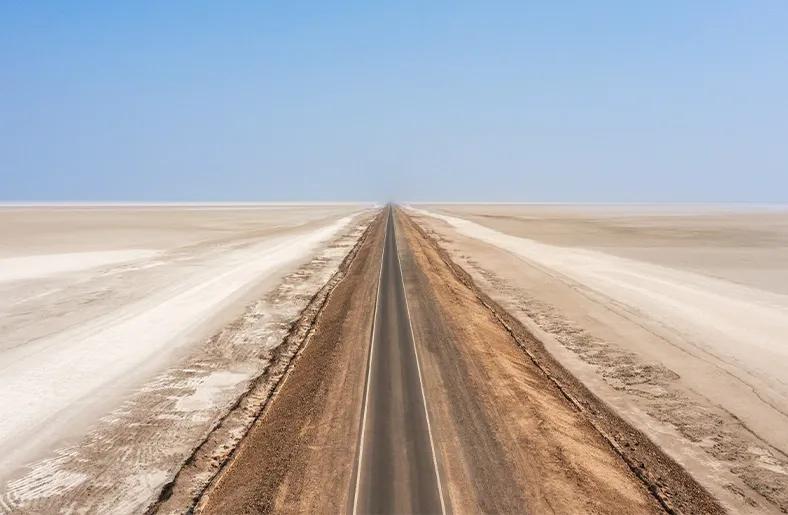
One Tripadvisor visitor drove out specifically for road to heaven kutch and found, in their own words, that delayed monsoon rains meant the water hadn't evaporated into the brilliant white salt plains the road is famous for "another case of right place at the wrong time." That honesty is exactly what most Instagram-driven guides to this road skip. Here's what the road actually is, when it genuinely delivers the effect, and the honest logistics behind the viral photos.
WHAT IS THE ROAD TO HEAVEN?
Road to heaven kutch refers to a stretch of the highway connecting Khavda village to Khadir Bet island, home of the Dholavira archaeological site, cutting straight through the Great Rann of Kutch. Construction began in 2019, and the Government of India specifically cleared and showcased the route around the 2023 G20 Summit held in Gujarat, positioning it as a key tourism and heritage connector to the UNESCO-listed Dholavira site.
What makes the drive genuinely remarkable is the optical effect it creates during the right conditions: seasonal salt marshes and shallow lakes flank the road on both sides, and when water levels are right, the horizon dissolves and the road appears to float between earth and sky. Greater flamingos frequently forage in these shallow, algae-rich wetlands alongside the drive, adding another genuinely photogenic element beyond the road itself.
HOW LONG IS THE ROAD TO HEAVEN? SORTING OUT THE CONFUSION
This is genuinely the most confusing part of researching this destination, and it's worth untangling properly. Most sources describe "the Road to Heaven" as a roughly 30 km stretch, with Wikipedia specifically citing a 31.9 km Khavda-Khadir road cleared ahead of the G20 Summit. But total distance figures from Khavda to Dholavira vary far more widely one detailed guide describes the actual straight, iconic stretch as beginning not at Khavda itself but at Adhav village, roughly 22 km further along, meaning the genuinely famous "floating" section is closer to 52 km total from Khavda. Another source puts the full Khavda-to-Dholavira distance at around 58 km, factoring in an initial single-lane village stretch before the main road begins.
None of these figures are necessarily wrong they're simply describing different segments of the same overall journey. Treat "30 km" as referring specifically to the iconic straight, water-flanked stretch, and budget closer to 50-58 km total if you're measuring the complete Khavda-to-Dholavira drive door to door.
Distance Description | Figure | What It Actually Measures "The Road to Heaven" (most commonly cited) | ~30 km | The iconic straight stretch through the Rann itself Officially cleared Khavda-Khadir road | 31.9 km | Government-cleared segment ahead of the 2023 G20 Summit Khavda to Adhav (approach road) | ~22 km | Single-lane village road before the main stretch begins Full Khavda to Dholavira | ~52-58 km | Complete door-to-door distance, sources vary
"Kutch Nahi Dekha To Kuch Nahi Dekha if you haven't seen Kutch, you haven't seen anything."
— Traditional Gujarati saying
WHY IT WENT VIRAL
Instagram spots kutch content didn't put this road on the map by accident a handful of specific creators are widely credited with the surge in attention. RJ Aditi Raval's Instagram reel, titled "Road to Heaven – Gujarat's Hidden Gem," is commonly cited as one of the first major viral posts to introduce the location to a wider audience, using cinematic drone angles over the water-flanked stretch. Travel vlogger Sai Chintala documented the Bhuj-to-Dholavira drive on YouTube in a video titled "The Road That Touches Heaven," describing the sensation of the horizon disappearing entirely. Travel creator Kanishk Gupta's visuals further amplified the road's reach across platforms.
That social media momentum is genuinely why heaven road kutch searches have grown so quickly but it's also why expectations sometimes outpace reality, as the Tripadvisor account in this guide's opening makes clear. The road is real and can be genuinely stunning; it just isn't guaranteed to look exactly like the most-viewed reel every time you visit.
Planning Your Kutch Trip?
Contact our travel experts for personalized assistance and custom itineraries.
BEST TIME TO VISIT: WATER REFLECTION VS DRY SALT
This is a nuance most competing guides miss entirely. November through February is the broadly recommended window, coinciding with Rann Utsav and Kutch's comfortable winter weather. But within that window, the specific visual effect you get changes meaningfully depending on exactly when you go.
Soon after monsoon retreat, typically October into early December, standing water is more likely to remain on both sides of the road, producing the strongest "floating on water" reflection effect and drawing more flamingo activity in the shallow wetlands. By January and February, the water has generally evaporated further into the hard, dry white salt crust that Kutch's Rann Utsav season is famous for still genuinely striking, but a different look: brilliant white salt rather than a mirrored water surface. Neither timing is objectively better; they're simply different versions of the same road, and it's worth deciding which effect you're actually chasing before you lock in your dates.
Timing | What You're Likely to See | Trade-off October-early December | Standing water, stronger reflection illusion, more flamingo activity | Slightly less predictable conditions given variable monsoon retreat timing January-February | Hard, dry white salt crust | Less water reflection, but aligns with peak Rann Utsav season and driest, most reliable conditions
HOW TO REACH THE ROAD TO HEAVEN
From Bhuj, the standard route runs via Khavda roughly 72-79 km depending on the exact source before continuing toward Adhav village and onto the main Road to Heaven stretch itself. If you're travelling from further afield, reaching Bhuj first is the practical starting point, since it's the district's air, rail and road gateway; see our how to reach kutch guide for the full breakdown from your specific city.
Road conditions have improved significantly since the route's 2019 construction and subsequent G20-era clearance, though facilities remain genuinely limited along the drive itself there are few shops or fuel stations once you're past Khavda, so prepare accordingly before setting out.
COST OF THE TRIP
Here's a realistic cost breakdown for a Road to Heaven excursion, per person, covering the drive from Bhuj.
Category | Budget | Mid-Range | Luxury Transport from Bhuj (round trip, shared) | ₹2,000-3,000 | N/A | N/A Private cab from Bhuj (round trip) | N/A | ₹6,000-8,500 | ₹9,500-13,000 (SUV) Combined with Dholavira visit (transport only) | ₹3,000-4,500 | ₹8,000-11,000 | ₹13,000-17,000 Photography/drone permissions (if applicable, check locally) | N/A | ₹500-1,000 | ₹1,500-2,500
Prices as of Month 4 (November 2026), built from typical long-distance Kutch cab rates for this remote stretch verify current transport costs before travelling, and confirm any current drone or photography restrictions locally given the route's proximity to a border-sensitive region.
12 PRACTICAL TIPS FOR VISITING THE ROAD TO HEAVEN
1. Check recent visitor reports or ask your operator about current water conditions before travelling the signature "floating" effect isn't guaranteed on every visit.
2. Decide whether you're chasing the water-reflection look or the dry-salt look, and time your visit accordingly rather than assuming both look the same.
3. Combine your drive with a Dholavira visit, since the road leads directly there and the two make natural sense as a single excursion.
4. Fill your tank in Bhuj or Khavda before setting out; fuel stations thin out considerably past Khavda.
5. Carry your own water and snacks, since facilities are genuinely limited along the route.
6. Drive during daylight hours specifically; this is remote terrain with limited lighting and services after dark.
7. Bring a proper camera or drone if photography is your main goal, since phone cameras can struggle to capture the scale of the horizon effect properly.
8. Confirm any current drone photography restrictions before flying one, given the route's proximity to a border-sensitive region.
9. Budget the full 50-58 km door-to-door distance from Khavda, not just the commonly quoted 30 km figure for the iconic stretch.
10. Mobile network coverage is unreliable along much of the route download offline maps before setting out.
11. Visit early morning or late afternoon for the most flattering light on the salt and water surfaces.
12. Manage your expectations against the most-viewed viral reels the road is genuinely beautiful, but conditions vary enough that your visit may look meaningfully different from any single video you've seen.
FREQUENTLY ASKED QUESTIONS
What is the Road to Heaven in Kutch? A roughly 30 km stretch of highway connecting Khavda to Dholavira through the Great Rann of Kutch, known for an optical illusion of floating on water created by seasonal salt marshes and shallow lakes on both sides.
How long is the Road to Heaven? The iconic straight stretch is commonly cited at around 30 km, though the full door-to-door distance from Khavda to Dholavira runs closer to 50-58 km depending on the source, since some measurements include the approach road before the main stretch begins.
Is the Road to Heaven always covered in water? No. The reflection effect depends on seasonal water levels, strongest soon after monsoon retreat in October-early December, and largely replaced by dry white salt crust by January-February. Delayed monsoon retreat can also affect conditions unpredictably.
How do I reach the Road to Heaven from Bhuj? Via Khavda, roughly 72-79 km from Bhuj, continuing onward through Adhav village to the main Road to Heaven stretch itself, which leads directly to Dholavira.
Is there an entry fee for the Road to Heaven? No formal entry fee has been consistently reported, since this is a public highway rather than a ticketed attraction, though confirm current conditions locally given the route's border-sensitive location.
When did the Road to Heaven become popular? Construction began in 2019, and the route gained wider public and tourist access around the 2023 G20 Summit held in Gujarat, after which viral Instagram and YouTube content from creators significantly accelerated its popularity.
Should I combine the Road to Heaven with a Dholavira visit? Yes, strongly recommended. The road leads directly to Khadir Bet island, where Dholavira sits, making it a natural single excursion rather than two separate trips.
FINAL VERDICT: IS THE ROAD TO HEAVEN WORTH THE DRIVE?
Yes, particularly if you're already planning a Dholavira excursion, since the road itself becomes part of that journey rather than a separate detour. Time your visit deliberately around whether you want the water-reflection look or the dry-salt look, and go in understanding that conditions genuinely vary the honest visitor accounts make clear this isn't a guaranteed postcard shot on every trip.
It's less essential if photography specifically isn't your priority and you're already committed to Dholavira via the standard route you'll still drive through much of this same corridor either way. But if the viral reels are what brought you to Kutch in the first place, build in flexibility around your dates and manage your expectations against real, current conditions rather than a single best-case video.
About the author: This guide was compiled by the IVARA Journeys travel team, who curate premium and pilgrimage travel packages across Gujarat, including Dholavira and Road to Heaven excursion planning. Last visited Kutch: November 2026.
Ready to add this drive to your Kutch itinerary? Talk to our Kutch travel expert (/contact) or explore our Rann Utsav packages (/packages/rann-utsav-kutch) and for the complete route from your own city, our how to reach kutch guide covers the full journey to Bhuj before you even reach Khavda.
Ready to Experience This?