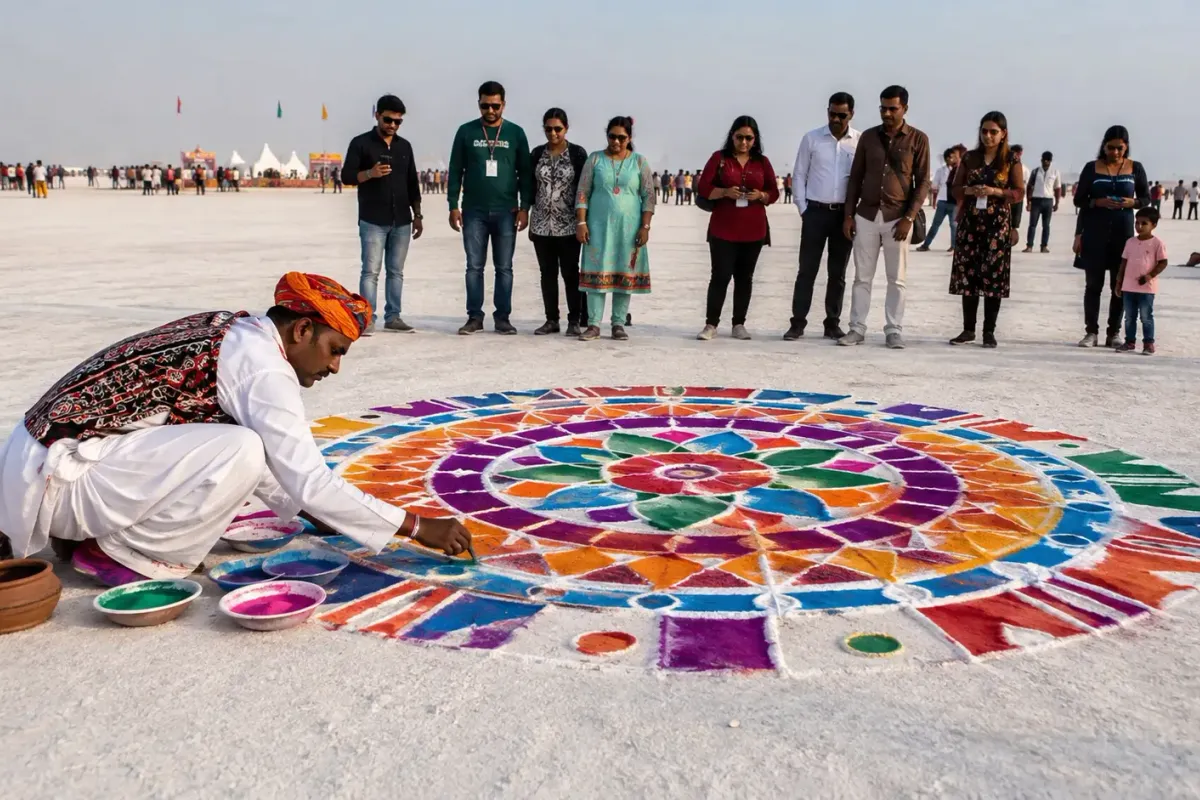
Two separate salt deserts share the name "Rann of Kutch," and mixing them up is the single most common planning mistake we see. The white rann of kutch that everyone pictures the glowing salt flat near Dhordo is part of the Great Rann. The Indian Wild Ass Sanctuary, a genuinely different place hours away, sits in the Little Rann. This guide covers exactly what the White Rann is, its real timings and entry fee, and how it differs from the Rann most searches accidentally conflate it with.
WHAT IS THE WHITE RANN OF KUTCH?
The white desert kutch refers to is the salt-crusted portion of the Great Rann of Kutch, a seasonal salt marsh covering roughly 7,500 square kilometres, officially recognised as a Ramsar Wetland of international importance since 5 November 2002. It's genuinely one of the largest salt deserts in the world, formed millions of years ago when tectonic movement separated this stretch of land from the Arabian Sea, leaving behind a vast, flat expanse that floods each monsoon and dries into brilliant white salt from around October through the following spring.
Here's the distinction most guides blur: the Rann of Kutch as a whole covers roughly 26,000-30,000 square kilometres and splits into two genuinely separate regions the Great Rann, where the White Rann and Rann Utsav sit, and the Little Rann, roughly 4,950-5,100 square kilometres, located southeast near Dhrangadhra and Surendranagar. The Little Rann is home to the Indian Wild Ass Sanctuary, protecting the endangered khur, and it's a completely different destination requiring its own separate trip not something you'll see on a standard Rann Utsav visit to Dhordo. If you've seen "Rann of Kutch wildlife safari" content online, that's almost certainly describing the Little Rann, not the White Rann this guide covers.
Great Rann of Kutch | Little Rann of Kutch ~7,500 sq km | ~4,950-5,100 sq km Location: north, near Dhordo and Khavda | Location: southeast, near Dhrangadhra Home to: White Rann, Rann Utsav, Flamingo City | Home to: Indian Wild Ass Sanctuary Access via: Khavda village | Access via: Dhrangadhra area
WHITE RANN TIMINGS AND PERMIT ACCESS
Because the White Rann sits in a border-sensitive zone patrolled by the BSF, every visitor needs a valid entry permit, checked at the Bhirandiyara checkpost roughly 55 km from Bhuj. White rann kutch timings for general access run 6:00 AM to 8:00 PM, extended to midnight specifically on full-moon nights so visitors can experience the salt glowing under moonlight the whole reason most people make this trip.
Carry a physical government photo ID at all times; this is a border-security formality tied to the Rann's proximity to the India-Pakistan boundary, not a suggestion. Permit processing can add unexpected time during peak Rann Utsav season, so build in a buffer rather than arriving right at your planned viewing window.
WHITE RANN ENTRY FEE
Indicative permit fees quoted by current booking guides run around ₹100 per adult and ₹50 per child aged 6-12, with children under 5 typically free. This rate is periodically revised by the state, so reconfirm the current figure before you travel rather than assuming last season's price still applies.
Most Rann Utsav Tent City packages bundle this permit into your overall booking, but not universally confirm explicitly with your specific operator whether the fee is included or charged separately at the checkpost. If you're visiting independently from a Bhuj base rather than staying at the Tent City, you'll need to arrange the permit yourself alongside your transport.
Ready to Book Your Kutch Trip?
Contact our travel experts for personalized assistance and custom itineraries.
BEST TIME TO VISIT THE WHITE RANN
Rann of kutch white desert conditions are only reliable from around October through February, since the salt crust needs the full retreat of monsoon water to harden properly. November through February is the practical viewing window, with January generally offering the driest, hardest salt of the entire year.
Time of day matters just as much as time of year. Sunset is the busiest viewing slot and delivers a genuinely striking transition as the white salt catches the changing light. A full-moon night, when access extends to midnight, is the single most sought-after experience the salt takes on a silver glow that's the reason most people plan their entire trip around a specific lunar date rather than just any winter week. Sunrise is a quieter, less crowded alternative that photographers specifically favour for softer light and thinner crowds.
"Kutch Nahi Dekha To Kuch Nahi Dekha if you haven't seen Kutch, you haven't seen anything."
— Traditional Gujarati saying
HOW TO REACH THE WHITE RANN
The White Rann is accessed via Khavda village, the last proper town before the salt flats begin. From Bhuj, budget roughly 80-85 km and about 1 hour 45 minutes by road to reach the Rann Utsav Tent City and the White Rann viewing point itself, passing through Khavda along the way.
Most Rann Utsav Tent City bookings include a fixed-timing transfer from Bhuj airport or railway station as part of the package. If you're based independently in Bhuj rather than staying at the Tent City, you'll need a private cab or self-drive vehicle for this leg, and mobile network coverage thins out noticeably once you're past Khavda download offline maps before you lose signal. For the full breakdown of getting to Bhuj itself from your specific city, see our surat to rann of kutch guide if you're travelling from South Gujarat, or check the dedicated guide for your own source city.
WHAT TO DO AT THE WHITE RANN
Beyond simply walking the salt flat itself, most visitors combine their White Rann visit with a camel cart or jeep ride across the flats, timed for sunset or the full-moon window. The Rann Utsav Tent City runs an evening cultural programme featuring Kutchi folk music and dance alongside the White Rann visit, giving the trip a fuller shape than just the salt desert alone.
Photography is the other major draw the flat, reflective salt surface creates genuinely unusual compositions, particularly around sunset and under full-moon light. If specific camera settings and timing for shooting the Rann matter to you, our dedicated rann utsav photography guide covers that in more depth than this general overview.
COST OF VISITING THE WHITE RANN
Here's a realistic cost breakdown covering permit, transport and the visit itself, per person.
Category | Budget | Mid-Range | Luxury White Rann entry permit | ₹100 (adult) | ₹100 (adult) | ₹100 (adult), often bundled into package Bhuj to Dhordo/White Rann transfer (round trip) | ₹800-1,200 (shared) | ₹1,500-2,500 (private cab) | ₹3,000-4,500 (private SUV) Camel cart or jeep ride at the Rann | ₹200-400 | ₹500-800 | ₹1,000-1,500 (private arrangement) Tent City accommodation (if staying overnight) | ₹6,300+ (Non-AC, 1N/2D) | ₹7,900-8,900 (Deluxe AC) | ₹15,000-25,000+ (Premium/Suite)
Prices as of Month 2 (September 2026), sourced from current permit-booking guides and Rann Utsav Tent City tariffs verify current fees before travelling, since both permit costs and accommodation rates are revised each season.
13 PRACTICAL TIPS FOR VISITING THE WHITE RANN
1. Confirm you're booking access to the Great Rann's White Rann, not a Little Rann wildlife safari these are genuinely different trips with different permits and locations.
2. Carry sunglasses regardless of season; the salt's daylight glare is bright enough to strain unprotected eyes within an hour.
3. Wear closed shoes rather than sandals the salt crust can be uneven and occasionally sharp underfoot.
4. Book full-moon dates 60-90 days ahead; these sell out first and the midnight-extended access window is specifically what most visitors are chasing.
5. Bring a proper warm layer for any evening or full-moon visit temperatures drop sharply after sunset even when the day felt warm.
6. Protect camera equipment from fine salt dust, which gets into lens seams and zip pockets more readily than regular sand.
7. Carry your government photo ID at all times; this is a border-security checkpoint requirement, not optional paperwork.
8. If visiting independently from Bhuj rather than staying at the Tent City, confirm your permit and transport arrangements before you leave, since options thin out once you're near Khavda.
9. Arrive at Bhirandiyara checkpost with time to spare during peak season; permit processing queues can add unexpected delay.
10. Download offline maps before heading past Khavda, where mobile network coverage drops noticeably.
11. If chasing full-moon photography specifically, arrive roughly 30 minutes before actual moonrise rather than at general sunset for the most dramatic light.
12. Don't assume every festival period aligns with a full moon check the specific lunar dates rather than assuming any given week delivers the glowing-salt experience.
13. If mobility is a concern for anyone in your group, ask about the walking distance from the parking or drop-off point to the salt flat itself, since this varies by exact viewing location.
FREQUENTLY ASKED QUESTIONS
What is the White Rann of Kutch? It's the salt-crusted portion of the Great Rann of Kutch near Dhordo village, a seasonal salt marsh that dries into a brilliant white crust from around October through February. It's the location of the Rann Utsav festival and Tent City.
Is the White Rann the same as the Little Rann of Kutch? No. The White Rann is part of the Great Rann, roughly 7,500 sq km, near Dhordo. The Little Rann, roughly 4,950-5,100 sq km, is a separate region near Dhrangadhra, home to the Indian Wild Ass Sanctuary a genuinely different trip.
What are the White Rann timings? General access runs 6:00 AM to 8:00 PM, extended to midnight on full-moon nights specifically. Permit checks happen at the Bhirandiyara checkpost, roughly 55 km from Bhuj.
How much is the White Rann entry fee? Indicative fees run around ₹100 per adult and ₹50 per child aged 6-12, with children under 5 typically free. Confirm the current rate before travelling, since this is periodically revised.
What is the best time to visit the White Rann? November through February for the season, with January offering the driest salt conditions. Within any visit, sunset or a full-moon night delivers the most striking experience, when access extends to midnight.
How far is the White Rann from Bhuj? Roughly 80-85 km, about 1 hour 45 minutes by road, accessed via Khavda village. Most Rann Utsav Tent City packages include this transfer as part of the booking.
Do I need to stay overnight to see the White Rann? No day-visitor access is available without a Tent City booking, though staying overnight is the only way to experience a full-moon night properly, since the midnight-extended access window is when the salt's glow is most dramatic.
FINAL VERDICT: IS THE WHITE RANN WORTH THE TRIP?
Yes, unreservedly, if you visit within the November-February window and specifically plan around a full-moon date rather than any random week the difference between a regular evening and a full-moon night at the White Rann is genuinely the difference between a nice desert view and the experience people travel across India for. Confirm your permit and transport arrangements ahead of time, and don't let the Little Rann's wildlife content online confuse your planning.
It's not worth rushing if you can't align your visit with decent salt conditions outside the winter season, there's simply no white desert to see, regardless of how flexible the rest of your schedule is. Plan it right, and this is genuinely the centrepiece worth building an entire Kutch trip around.
About the author: This guide was compiled by the IVARA Journeys travel team, who curate premium and pilgrimage travel packages across Gujarat, including White Rann-specific trip planning and permit arrangements. Last visited Kutch: September 2026.
Ready to plan your White Rann visit properly? Talk to our Kutch travel expert (/contact) or explore our Rann Utsav packages (/packages/rann-utsav-kutch) and for the exact season dates and full-moon calendar to plan around, our rann utsav dates guide covers the specifics.
Ready to Experience This?